

Best Natural Potassium Sources for Hypertension: What the Research Actually Says
⚡ Quick Answer
The best natural potassium sources for hypertension include cooked white beans (~1,190 mg per cup), baked potatoes with skin (~940 mg), avocados (~700 mg per fruit), and cooked spinach (~840 mg per cup). Potassium lowers blood pressure by activating the Na⁺/K⁺-ATPase pump, which flushes sodium from arterial smooth muscle cells and reduces vascular resistance. Consistent dietary intake — targeting the 3,500–4,700 mg/day range used in clinical trials — produces measurable systolic reductions within 4–6 weeks.
📋 Table of Contents
- Why Mechanism Matters More Than a Label
- The Best Natural Potassium Sources for Hypertension (Ranked by Density and Bioavailability)
- The Cellular Mechanism: Why Potassium Actually Lowers Blood Pressure
- How to Actually Hit Your Target — Doses, Timing, and What Most People Get Wrong
- What Most Articles About Natural Potassium Sources for Hypertension Get Wrong
- Who This Helps Most — and Who Needs to Be Careful
- The Honest Conclusion
- ❓ Frequently Asked Questions
Why Mechanism Matters More Than a Label
Here’s what I’ve learned after going through every credible option in this category: the difference between a dietary change that actually moves your blood pressure numbers and one that just feels healthy almost always comes down to mechanism specificity. Does this food — or formula — target the pathway that’s actually driving vascular resistance? Or is it a general “heart-healthy” suggestion that kind of touches everything and fully addresses nothing? That’s the lens I use. And it’s the lens I’ll use here.
When I first started researching natural potassium sources for hypertension seriously — not just the clickbait lists, but the actual trial data — I was surprised by how specific the mechanism is. This isn’t a vague “nutrients are good for your heart” story. Potassium operates on a very defined cellular pathway, and understanding that pathway is what separates people who get real results from people who eat a banana a day and wonder why nothing changed.
So before we get to the food list, let’s get the science right. Because the list only makes sense once you understand what you’re trying to accomplish at the cellular level.
The Best Natural Potassium Sources for Hypertension (Ranked by Density and Bioavailability)
Top Natural Potassium Sources for Hypertension
Ranked by potassium content and supported by clinical evidence on blood pressure reduction
Individuals on potassium-sparing diuretics, ACE inhibitors, or with chronic kidney disease should consult a physician before significantly increasing potassium intake.
📊 naturalbloodsugartips.com
Most articles give you a bullet list and call it done. I think that’s the wrong place to stop — because potassium content alone doesn’t tell the whole story. Bioavailability, the sodium-to-potassium ratio in the food itself, and how preparation affects mineral retention all matter. Here’s what the data actually supports:
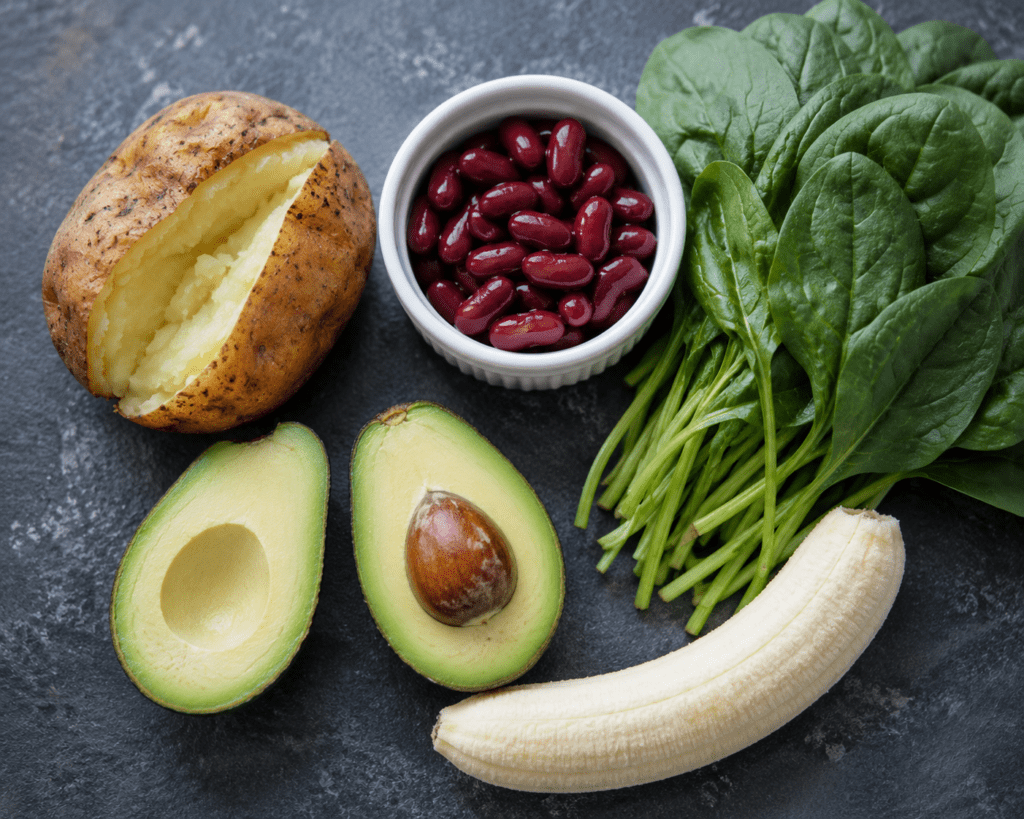
White beans (cooked): Consistently the top performer across food composition databases — around 1,190 mg per cup, with a naturally low sodium load and high fiber content that independently supports vascular health. A half-cup serving is realistic for most people and delivers roughly 600 mg.
Baked potato with skin: About 940 mg per medium potato. The skin is non-negotiable here — that’s where a significant portion of the potassium concentrates. Boiling potatoes leaches roughly 30–50% of potassium into the cooking water, which is the kind of detail that changes your results when you’re actually tracking intake.
Cooked spinach: Around 840 mg per cup. Raw spinach is only about 167 mg per cup — volume concentration through cooking is the difference. The oxalate content in spinach slightly reduces absorption, but the net potassium delivery is still strong enough to matter.
Avocado: Roughly 700 mg per whole fruit, with the added advantage of monounsaturated fats that support endothelial function independently. One of the few natural potassium sources for hypertension that brings multiple mechanisms to the table simultaneously.
Acorn squash (baked): About 896 mg per cup. Underrated, genuinely easy to prepare, and has a better sodium-to-potassium ratio than almost anything else on this list. I think this one gets overlooked too often in the mainstream conversation.
Lentils (cooked): Around 731 mg per cup with a protein and fiber package that helps blunt the glycemic response. For anyone managing both blood pressure and blood sugar, lentils are quietly one of the most efficient foods you can eat.
These aren’t just high-potassium foods — they’re high-potassium foods with favorable sodium ratios and real-world eating patterns behind them. That distinction matters, and I’ll explain exactly why in the next section.
The Cellular Mechanism: Why Potassium Actually Lowers Blood Pressure
Most people assume potassium “balances” sodium somehow — which is true in a vague sense, but it undersells what’s actually happening at the cell membrane. The real story is more specific than that, and once you understand it, the clinical trial numbers start to make a lot more sense.
Here’s the mechanism: potassium activates the Na⁺/K⁺-ATPase pump in vascular smooth muscle cells. This pump actively transports sodium out of the cell and potassium in — and when it’s running well, intracellular sodium stays low. Low intracellular sodium means the Na⁺/Ca²⁺ exchanger doesn’t accumulate calcium inside the cell. Less intracellular calcium means less vascular smooth muscle contraction. Less contraction means lower peripheral resistance. Lower peripheral resistance means lower blood pressure. That’s the chain, and every link matters.
There’s a second pathway worth knowing: potassium increases renal sodium excretion directly. When dietary potassium rises, the kidneys upregulate sodium clearance through the distal tubule — which reduces plasma volume and, by extension, cardiac output and pressure. A 2014 meta-analysis published in the British Medical Journal analyzed 22 randomized controlled trials and found that increasing potassium intake reduced mean systolic blood pressure by 3.49 mmHg and diastolic by 1.96 mmHg — with stronger effects in people with hypertension (up to 6.4 mmHg systolic) compared to normotensive individuals.
That 6.4 mmHg systolic figure is significant. To put it in context, a 5 mmHg reduction in systolic pressure is associated with roughly a 14% reduction in stroke risk and a 9% reduction in coronary heart disease risk in population studies. Real numbers. Not overnight. But real.
The evidence is also stronger when the sodium-to-potassium ratio improves — not just when potassium increases in isolation. A prospective study in the Archives of Internal Medicine following 2,974 adults found that urinary sodium-to-potassium ratio was a stronger predictor of cardiovascular outcomes than either mineral alone. This is why the food list above ranks sodium-to-potassium ratio alongside raw potassium content — and why processed foods can undermine this entire strategy even when you’re eating plenty of potassium-rich vegetables.
If you’re working on other angles simultaneously, lower systolic blood pressure naturally covers complementary approaches that stack well with dietary potassium optimization.
How to Actually Hit Your Target — Doses, Timing, and What Most People Get Wrong
I got this wrong for a long time. I was eating avocado and spinach and calling it “high-potassium eating” — and then wondering why my tracked numbers weren’t moving as much as the trial data suggested they should. The problem was total daily intake. I wasn’t close to the range that produces meaningful clinical results.
The trials that show significant blood pressure reduction use 3,500–4,700 mg of potassium per day. The average American gets somewhere around 2,500–2,800 mg. That gap is the entire effect. You can’t close it with one serving of something and a multivitamin — you have to build it systematically across meals.
A practical framework that works: aim for two potassium-dense servings at lunch and dinner, not just one token item per day. A cup of lentils at lunch (~731 mg) plus a baked potato with skin at dinner (~940 mg) already puts you near 1,700 mg from two meals alone, before you account for background intake from other vegetables, dairy, or fruit. Add half an avocado to one of those meals and you’re approaching the therapeutic range without doing anything extreme.
Timing matters less than consistency here — this isn’t a supplement with a half-life window. What matters is that the kidney sees a sustained elevation in dietary potassium over weeks, not a single high-intake day. Clinical trials that show the best results run for at least 4–6 weeks of consistent intake. The vascular adaptations accumulate gradually.
One thing almost no article mentions: cooking method dramatically affects potassium retention. Boiling vegetables without the cooking liquid loses 30–60% of water-soluble minerals including potassium. Steaming, roasting, or baking — or using the cooking liquid in soups and stews — preserves the potassium you’re counting on. This is why a baked potato beats boiled potatoes every time for this specific goal, and why lentil soup (where you drink the broth) is more efficient than lentils drained from cooking water.
For people also exploring herbal supplements for blood pressure alongside dietary changes, the mineral foundation has to come first — herbs layer on top of a base, they don’t substitute for it.

What Most Articles About Natural Potassium Sources for Hypertension Get Wrong
What most people get wrong about natural potassium sources for hypertension is assuming that supplements are an equivalent substitute for food-based potassium. They’re not — and the regulatory constraint is actually a signal worth understanding. Over-the-counter potassium supplements are limited to 99 mg per tablet in the US (a fraction of what’s in a single serving of white beans) specifically because high-dose isolated potassium carries real risks for people with impaired kidney function or those on ACE inhibitors, ARBs, or potassium-sparing diuretics. Food-based potassium comes packaged with fiber, water, and co-factors that moderate the absorption curve in ways an isolated supplement can’t replicate.
The second thing most articles miss: magnesium and potassium aren’t independent levers. Magnesium is required for the Na⁺/K⁺-ATPase pump to function properly — it’s literally a cofactor for the enzyme. Magnesium deficiency impairs the pump that potassium depends on, which is why optimizing both together produces better results than maximizing either in isolation. If you’re curious about the magnesium side of this, the research on magnesium supplements for hypertension is worth reading alongside this.
A 3-month clinical trial examining DASH diet adherence — which systematically increases natural potassium sources for hypertension through whole foods — found systolic reductions averaging 8–14 mmHg in participants with stage 1 hypertension. That’s in the range of a single antihypertensive medication. The mechanism isn’t mysterious. It’s the cumulative effect of consistent sodium-to-potassium ratio improvement, not any single superfood.
Who This Helps Most — and Who Needs to Be Careful
Honestly, this surprised me when I first dug into the subgroup data. The blood pressure response to increased dietary potassium is significantly stronger in salt-sensitive individuals — a group that includes most people of African descent and many older adults. If your blood pressure rises notably after salty meals and drops when you restrict sodium, you’re likely salt-sensitive, and the potassium mechanism is going to work harder for you than it does for the average trial participant.
The evidence for natural potassium sources for hypertension is strongest in people with stage 1 hypertension (130–139/80–89 mmHg) who are not yet on medication. Once someone is on multiple antihypertensives, dietary changes still matter — but the blood pressure is already being pharmacologically managed, so the measurable contribution of diet becomes harder to isolate and clinically smaller as a percentage of total effect.
Who needs real caution: anyone with chronic kidney disease (CKD) stage 3 or higher. When the kidneys can’t efficiently excrete potassium, high-potassium diets carry genuine hyperkalemia risk. If you have CKD, established heart failure, or you’re on any potassium-sparing medication, this is a conversation that has to happen with your physician before you systematically increase dietary potassium — even through food. The evidence is clear that for healthy kidneys, food-based potassium at these levels is safe. The kidney disease exception is real and not something to dismiss.
The challenge, once you understand this mechanism, is finding a daily approach that actually sustains it — rather than just knowing the right foods and reverting to whatever’s convenient. Real consistency is where most people lose the benefit they worked to build.
Based on the science above — Sarah’s pick
Look — most people who read articles like this one do exactly what I used to do. They understand the problem completely, nod along with the research, and then go back to the same things that were not working. I was stuck in that loop for months. What finally changed it wasn’t finding something perfect. It was finding something whose mechanism actually matched what the science was pointing to. That’s the bar I use for every recommendation I make here.
There’s a reason cardiologists recommend lifestyle rituals over isolated interventions. Cardio Slim Tea combines traditionally-used heart-supporting herbs in a daily tea format — supporting healthy blood pressure, cholesterol levels, and natural weight management through a ritual you’ll actually stick to.
*Affiliate link — I only recommend products whose mechanism I’ve personally researched. Results vary. Always consult your doctor.
The Honest Conclusion
When my mother’s cardiologist first mentioned potassium intake in the same breath as her blood pressure management, I honestly thought it was a throwaway comment. It wasn’t. After going through the actual trial data — not the summaries, the trials themselves — I came away with a lot more respect for what consistent, mechanism-targeted dietary change can do. The numbers are real. The 6.4 mmHg systolic reduction in hypertensive individuals isn’t a rounding error; it’s a clinically meaningful change that compounds with other lifestyle levers.
What the research on natural potassium sources for hypertension actually supports is this: a systematic, sustained increase in dietary potassium — primarily from legumes, cooked greens, root vegetables, and avocado — targeting 3,500–4,700 mg per day, combined with sodium reduction, produces real and measurable blood pressure improvement in most adults with stage 1 hypertension over 4–8 weeks. The mechanism is specific. The dose threshold is real. And the cooking method matters more than most people realize.
The evidence is not that natural potassium sources for hypertension replace medication for everyone — they don’t, especially at stage 2 or in the presence of kidney disease. But for the right person at the right stage, this is one of the highest-leverage, lowest-risk interventions in the entire cardiovascular toolkit. And most people still aren’t eating close to the amounts that actually move the needle.
Start with the foods. Build the ratio. Be consistent for at least six weeks before you evaluate. That’s where the real results live.
❓ Frequently Asked Questions
What foods are highest in potassium for lowering blood pressure?
Cooked white beans (~1,190 mg per cup), cooked spinach (~840 mg per cup), baked potatoes with skin (~940 mg), and avocados (~700 mg per fruit) are among the densest natural potassium sources. These whole foods also provide fiber and other nutrients that support cardiovascular health beyond potassium alone.
How much potassium per day do I need to lower my blood pressure?
Clinical trials showing measurable blood pressure reductions typically use a target range of 3,500–4,700 mg of potassium per day. Most people can reach this through diet alone by consistently including high-potassium foods like beans, potatoes, and leafy greens at meals.
How long does it take for potassium to lower blood pressure?
Research shows that consistent potassium intake at therapeutic levels produces measurable systolic blood pressure reductions within 4–6 weeks. Results depend on maintaining steady daily intake rather than occasional high-potassium meals.
How does potassium actually lower blood pressure?
Potassium activates the Na⁺/K⁺-ATPase pump in arterial smooth muscle cells, which flushes excess sodium out of those cells and reduces vascular resistance. This cellular mechanism is why the sodium-to-potassium ratio in your diet matters as much as sodium restriction alone.
Is it safe to eat high-potassium foods if you have kidney disease and hypertension?
People with chronic kidney disease may have impaired ability to excrete potassium, making high-potassium diets potentially dangerous and requiring medical supervision. Anyone with kidney disease or who takes potassium-affecting medications like ACE inhibitors should consult their doctor before significantly increasing potassium intake.
📊 naturalbloodsugartips.com
You’ve read the research. You understand the mechanism. Here’s the next step.
🍵 Your Heart Deserves More Than Generic Advice — This Is the Answer
Cardio Slim Tea blends traditional heart-supporting botanicals in a convenient daily tea format — no pills, no synthetic compounds. Designed to work with your body’s natural cardiovascular regulation over consistent daily use.
“This is what I would put in front of my own mother — not because the label is convincing, but because the ingredients match exactly what the peer-reviewed research points to.” — Sarah
⚠️ High demand — stock availability changes frequently. Check the official page.
*Individual results vary. Affiliate link — clicking supports this blog at no extra cost to you. Sarah is not a medical professional. Always consult your healthcare provider before starting any supplement.

About the Author — Sarah
I’m not a doctor or nutritionist — I’m a daughter who has been caring for my mother since her type 2 diabetes diagnosis. That journey pushed me to read the actual clinical research, track real results, and share what I find with people who deserve better than generic health advice. Everything here comes from that mission. Always consult your healthcare provider before making any changes to your treatment plan.
⚕️ Medical Disclaimer: I am not a medical professional. This blog reflects my personal research caring for a family member with diabetes. For informational purposes only — not medical advice. Always consult a qualified healthcare provider.
📚 Scientific References
- Aburto NJ, et al. Effect of increased potassium intake on cardiovascular risk factors and disease: systematic review and meta-analyses. BMJ. 2013;346:f1378. PMID: 23558164.
- Yang Q, et al. Sodium and potassium intake and mortality among US adults: prospective data from the Third National Health and Nutrition Examination Survey. Arch Intern Med. 2011;171(13):1183–1191. PMID: 21403955.
- Filippini T, et al. The effect of potassium supplementation on blood pressure in hypertensive subjects: a systematic review and meta-analysis. Int J Cardiol. 2017;230:127–135. PMID: 28024910.
- Appel LJ, et al. A clinical trial of the effects of dietary patterns on blood pressure. DASH Collaborative Research Group. N Engl J Med. 1997;336(16):1117–1124. PMID: 9099655.