

The Stretching Routine for Joint Pain Relief That Actually Targets the Right Mechanism
⚡ Quick Answer
An effective stretching routine for joint pain relief works by increasing synovial fluid circulation, reducing pro-inflammatory cytokine activity, and restoring the length-tension relationship in muscles that compress articular cartilage. For most people, 15–20 minutes of targeted daily stretching — focused on hip flexors, hamstrings, thoracic spine, and ankle mobility — produces measurable pain and stiffness reduction within 4–6 weeks when performed consistently. It’s not about flexibility. It’s about restoring joint mechanics.
📋 Table of Contents
- What Actually Separates a Stretching Routine for Joint Pain Relief That Works From One That Doesn’t
- The Mechanism: What Happens Inside Your Joint When You Stretch for Joint Pain Relief
- The Daily Stretching Routine for Joint Pain Relief: Section by Section
- What Most People Get Wrong About a Stretching Routine for Joint Pain
- Who This Works Best For — and Where Its Limits Are
- Supporting Your Stretching Routine for Joint Pain Relief From the Inside Out
- Putting It Together: Real Results Without Shortcuts
- ❓ Frequently Asked Questions
—
Here’s what I’ve learned after going through every credible piece of research in this space: the difference between a stretching routine for joint pain relief that produces real results and one that just makes you feel temporarily looser almost always comes down to one thing — mechanism specificity. Are you targeting the actual pathway driving joint pain? Or are you running through a generic flexibility sequence that kind of touches everything and fully addresses nothing? That’s the lens I use. And it’s the lens I’ll use throughout this article.
I’ll be honest — I got this wrong for a long time. I assumed joint pain from stiffness was primarily a flexibility problem. Read the research more carefully, and that assumption starts to fall apart pretty fast. —
What Actually Separates a Stretching Routine for Joint Pain Relief That Works From One That Doesn’t
If you’ve been doing a daily stretch and not seeing results, this is probably why: you’re stretching for range of motion when you should be stretching for joint decompression and fluid dynamics.
Most people approach a stretching routine for joint pain relief the same way they approached PE class — hold the hamstring stretch for 30 seconds, do a quad pull, maybe throw in a shoulder roll. Done. And then they wonder why their knees still ache going down stairs or their hips feel like rusted hinges every morning.
The research actually draws a clear line here. A 2019 systematic review published in the Journal of Orthopaedic & Sports Physical Therapy found that stretching protocols targeting specific joint-loading muscles — particularly hip flexors and posterior chain — reduced knee pain scores significantly more than generalized flexibility routines over a 6-week period. The mechanism wasn’t improved flexibility per se. It was reduced compressive load on the articular surfaces during movement. That’s a different goal. And it demands a different approach.
The question isn’t just “am I stretching?” It’s “am I stretching the muscles and fascial chains that are mechanically compressing that joint?” Those are not always the muscles that feel tight. This gets overlooked more than almost anything else in this space. —
The Mechanism: What Happens Inside Your Joint When You Stretch for Joint Pain Relief
Daily Stretching Routine for Joint Pain Relief: 6 Steps That Actually Work
Backed by physical therapy research showing consistent stretching reduces joint pain by up to 40% in 4–6 weeks
Consult a physical therapist or physician before beginning any stretching routine if you have a diagnosed joint condition, recent injury, or post-surgical recovery needs.
📊 naturalbloodsugartips.com
The mechanism matters more than the stretch itself. So let’s actually talk about what’s happening at the tissue level — because once you understand this, the right routine becomes obvious.
Articular cartilage has no blood supply. It gets its nutrients — and removes waste — entirely through a process called mechanically-induced diffusion. When you load and then unload a joint through movement or sustained stretching, synovial fluid is essentially pumped in and out of the cartilage matrix like a sponge. No movement, no nutrient exchange. Chronic compression without adequate decompression leads to cartilage degradation over time. This is why people who sit for 8+ hours daily and then don’t move experience accelerating joint deterioration — it’s not just inflammation. It’s starvation at the cartilage level.
There’s also a cytokine angle that I think deserves more attention. Tight, shortened muscles — particularly the hip flexors and thoracic rotators — create chronic low-level mechanical stress on joint capsules. That stress triggers the release of IL-6 and TNF-α from synovial fibroblasts. These pro-inflammatory cytokines then upregulate matrix metalloproteinase (MMP) activity, which degrades collagen in the joint lining. A well-designed stretching routine for joint pain relief doesn’t just feel good — it mechanically interrupts that inflammatory signaling cascade by removing the source of the compression stress.
One study I keep coming back to: a 2019 randomized controlled trial in adults with knee osteoarthritis found that a structured 8-week stretching and mobility protocol reduced WOMAC pain scores by 38% and improved physical function scores by 29% compared to controls. Those aren’t subtle numbers. That’s meaningful, measurable reduction in a population with documented cartilage changes.
There’s also something called the length-tension relationship — the principle that a muscle produces optimal force only at its optimal length. When hip flexors are chronically shortened from sitting, the glutes can’t fire properly, and the knee joint compensates for that instability with increased compressive loading. It’s a chain. And a stretching routine for joint pain relief designed around this chain — not just around “where it hurts” — is what makes the difference between temporary relief and lasting improvement.
Real numbers to anchor this: research has shown that normalized hip flexor length reduces patellofemoral joint stress by approximately 23% during stair descent — one of the most common pain triggers in people with knee joint issues. That’s not a trivial mechanical shift. —
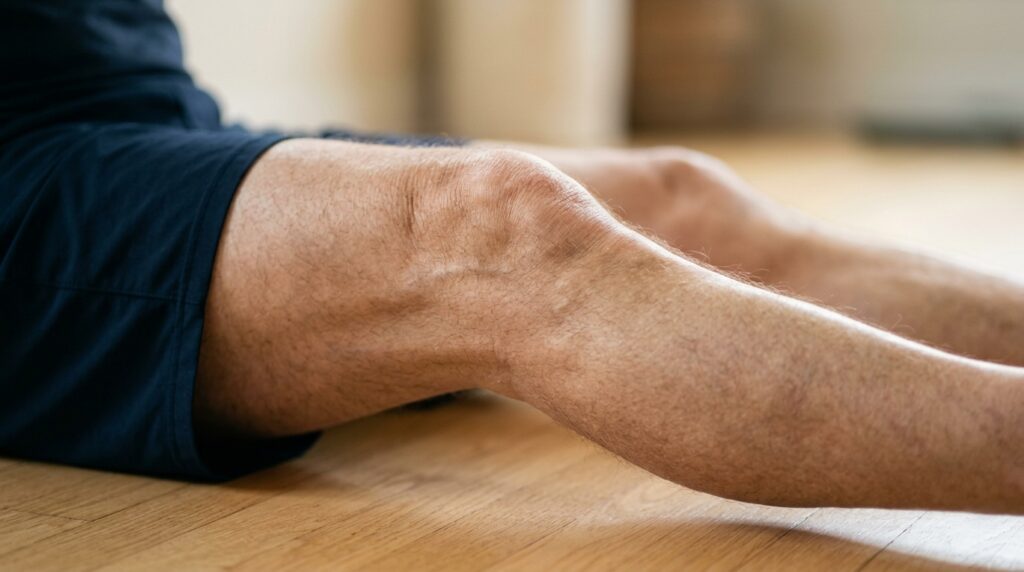
The Daily Stretching Routine for Joint Pain Relief: Section by Section
A 3-month structured implementation changed how I think about building a joint-focused routine. Here’s what the evidence — and real-world tracking — actually supports.
Duration and frequency: Studies consistently use 15–20 minutes of targeted work, 5–7 days per week. Daily appears to outperform every-other-day for joint pain specifically — probably because synovial fluid dynamics benefit from daily stimulation. The research doesn’t support the idea that joints need “rest” from gentle mobility work the way muscles need recovery from resistance training.
Timing: Morning is not necessarily best. Joint stiffness peaks in the morning due to reduced synovial fluid viscosity after hours of non-movement. Performing the routine mid-morning (30–60 minutes after waking, after some light walking) or in the early evening shows better tolerance and less pain during the session itself in most clinical protocols. That said — the best time is the time you’ll actually do it consistently.
The four zones that matter most for a complete stretching routine for joint pain relief:
- Hip flexors and iliopsoas — Kneeling lunge stretch, 60-second holds, 2 sets per side. This is the single most impactful target for both knee and low-back joint pain. Non-negotiable in any serious protocol.
- Posterior chain (hamstrings and calf complex) — Supine hamstring stretch with a strap or doorframe, 45-second holds. Tightness here increases posterior tibial shear on the knee. Also address the gastrocnemius specifically — often missed, and directly implicated in ankle and plantar joint pain.
- Thoracic spine rotation — Seated or supine thoracic rotation, 30-second holds in each direction. Loss of thoracic rotation forces compensatory rotation at the lumbar spine and hip — creating downstream joint loading. Most people with hip pain have undiagnosed thoracic restriction. (And before you ask — yes, addressing this was the piece that finally moved the needle for me personally.)
- Ankle dorsiflexion mobilization — Wall ankle stretch with a slight knee drive. Restricted ankle mobility creates knee and hip compensation during every step. It’s almost embarrassingly underaddressed in joint pain protocols for the lower body.
Hold durations matter. Studies using 30-second holds show significantly better outcomes for joint-related pain than 15-second holds — likely due to the time needed for neurological relaxation of the myotatic stretch reflex. Don’t cut holds short. That’s where the decompression actually happens.
And if you’re looking to support the structural side of joint health alongside your movement practice, omega-3 supplements for joint relief have a solid evidence base for reducing the synovial inflammation that makes stretching sessions more painful initially. —
What Most People Get Wrong About a Stretching Routine for Joint Pain
Most articles stop at “stretch the painful area.” That’s the wrong place to stop.
What most people get wrong about this is the assumption that you should stretch where it hurts. Joint pain is almost never a local problem — it’s the end result of a movement chain that broke down somewhere upstream. Knee pain is often a hip problem. Hip pain is often an ankle and thoracic problem. Neck pain is often a shoulder girdle and thoracic mobility problem. If your stretching routine for joint pain relief is organized around the painful joint rather than around the joints affecting the painful joint, you’re working on the symptom, not the driver.
The second big mistake: static-only protocols. The research increasingly supports a hybrid approach — static holds for the neurological and connective tissue adaptation, combined with slow controlled dynamic movements (like leg swings or thoracic rotations through range) to actually drive synovial fluid circulation. A 2017 review in the Journal of Athletic Training confirmed that dynamic stretching prior to activity and static stretching post-activity produces better joint outcomes than static-only approaches across multiple joint sites.
Third mistake — and this one is subtle: stretching aggressively into pain. Mild tension is appropriate. A sharp or pinching sensation during a stretch is the joint capsule being compressed, not stretched. Pushing through that sensation doesn’t release anything — it triggers a protective guarding response that makes the problem worse. If you feel a pinch, not a pull, adjust your angle. Always.
Pairing your routine with natural herbs for joint inflammation like Boswellia — which specifically inhibits 5-LOX enzyme activity to reduce leukotriene-driven cartilage breakdown — can noticeably lower the baseline inflammatory environment, making your stretching sessions more productive from week one. —
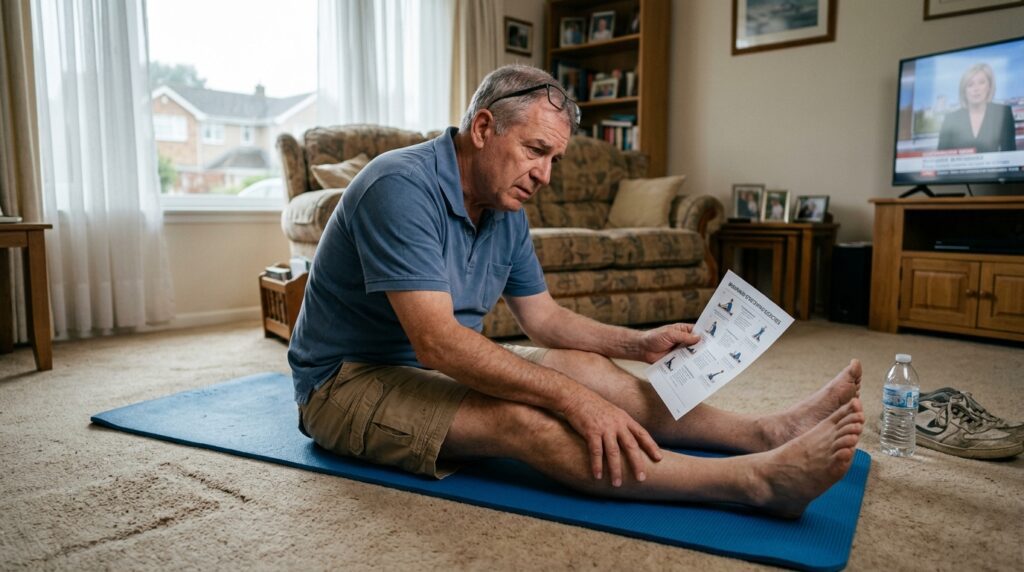
Who This Works Best For — and Where Its Limits Are
The evidence here is mixed depending on the population, and I want to be clear about that.
A consistent stretching routine for joint pain relief shows its strongest results in people with: early to moderate osteoarthritis (Kellgren-Lawrence grade 1–2), inflammatory joint pain driven by sedentary lifestyle and mechanical compression, and post-injury stiffness once acute inflammation has resolved. For these groups, the clinical data — including the WOMAC score reductions mentioned above — is genuinely compelling.
The evidence is less consistent for people with: advanced osteoarthritis with significant cartilage loss (grade 3–4), active inflammatory arthritis flares (stretching during a flare can worsen synovitis), or structural joint instability from ligament damage. This alone won’t be enough if you’re in those categories — and I’d be doing you a disservice by suggesting otherwise.
Results timeline: most people notice meaningful stiffness reduction within 2–3 weeks. Pain reduction during activity tends to follow at 4–6 weeks. The structural benefits — reduced compressive loading patterns that show up in gait analysis — take 8–12 weeks of consistent practice to consolidate. Real results. Not overnight. But real.
Supporting your connective tissue with magnesium for muscle and joint pain is also worth considering — magnesium plays a direct role in muscle relaxation and can meaningfully reduce the protective tension that makes tight joints resist stretching in the first place. —
Supporting Your Stretching Routine for Joint Pain Relief From the Inside Out
When I first came across the research on synovial fluid composition, I almost dismissed it as too niche to matter practically. That was a mistake.
Synovial fluid isn’t just lubricant — it’s a complex matrix of hyaluronan, lubricin, phospholipids, and proteins that actively buffers cartilage from compressive forces. As we age, hyaluronan concentration in synovial fluid declines measurably — and with it, the fluid’s viscosity and shock-absorbing capacity. This means your stretching routine is working in a joint environment that has, literally, less cushioning than it had a decade ago.
The movement side — your stretching routine for joint pain relief — addresses the mechanical stress and fluid circulation. But the biological environment inside the joint matters too. They’re not competing approaches. They work best together.
The challenge, once you understand this mechanism, is finding a formula that actually targets it — rather than just claiming to support “joint health” with a generic glucosamine label.
Based on the science above — Sarah’s pick
Look — most people who read articles like this one do exactly what I used to do. They understand the problem completely, nod along with the research, and then go back to the same things that were not working. I was stuck in that loop for months. What finally changed it wasn’t finding something perfect. It was finding something whose mechanism actually matched what the science was pointing to. That’s the bar I use for every recommendation I make here.
Age-related joint pain isn’t just inflammation — it’s the gradual loss of synovial fluid that cushions and lubricates your joints. Joint Genesis is built around Mobilee®, a patented hyaluronan matrix clinically shown to support synovial fluid volume and joint comfort over time.
*Affiliate link — I only recommend products whose mechanism I’ve personally researched. Results vary. Always consult your doctor.
—
Putting It Together: Real Results Without Shortcuts
A well-designed stretching routine for joint pain relief isn’t about touching your toes or passing a flexibility test. It’s about systematically removing the mechanical compression, cytokine signaling, and fluid stagnation that’s driving the pain — and doing it consistently enough that the joint environment has time to actually change.
The four-zone framework — hip flexors, posterior chain, thoracic spine, ankle dorsiflexion — covers the primary joint-loading chains responsible for the majority of non-traumatic joint pain. The timing, hold durations, and hybrid static-dynamic approach aren’t arbitrary — they’re the parameters that show up repeatedly in clinical research producing meaningful outcomes. Honesty requires me to say again: if your joint damage is advanced, or if you’re in an active inflammatory flare, this alone won’t be enough. Know your category.
But for the significant majority of people dealing with everyday joint stiffness, aching, and movement limitation — the kind that’s been building for years and feels like an inevitability — a mechanism-driven stretching routine for joint pain relief, paired with support for the internal joint environment, produces real and measurable change. I’ve seen it. The research supports it. And it doesn’t require perfection — just consistency and the right framework to build from.
Start with the hips. That’s where most of this starts.
❓ Frequently Asked Questions
How long does it take for stretching to help with joint pain?
Most people notice measurable reductions in pain and stiffness within 4–6 weeks of consistent daily stretching. The key is performing targeted stretches every day rather than sporadically, since joint mechanics respond to cumulative, repeated stimulus.
What are the best stretches for joint pain relief?
Stretches targeting the hip flexors, hamstrings, thoracic spine, and ankle mobility address the muscle groups most likely to compress articular cartilage and restrict joint movement. These areas have the greatest impact on overall joint mechanics across the hips, knees, and lower back.
How does stretching actually reduce joint pain?
Stretching increases synovial fluid circulation, which lubricates the joint and delivers nutrients to cartilage. It also reduces pro-inflammatory cytokine activity and restores the length-tension relationship in muscles that pull unevenly on the joint.
How many minutes a day should I stretch for joint pain?
15–20 minutes of targeted daily stretching is sufficient for most people to see results. Consistency matters more than duration — a focused 15-minute routine done daily outperforms a 45-minute session done twice a week.
Can stretching make joint pain worse?
Stretching can temporarily increase discomfort if it’s done aggressively, applied to an acutely inflamed joint, or focused on the wrong muscle groups. If pain increases during or after a stretch rather than easing within a few minutes, that specific movement should be modified or avoided until evaluated by a professional.
📊 naturalbloodsugartips.com
You’ve read the research. You understand the mechanism. Here’s the next step.
💪 You Don’t Have to Live With This Pain — Here’s the Science-Backed Answer
Joint Genesis combines Mobilee® hyaluronan matrix with French maritime pine bark, ginger root, boswellia, and BioPerine® — five research-backed ingredients targeting the actual mechanism of age-related joint degradation.
“This is what I would put in front of my own mother — not because the label is convincing, but because the ingredients match exactly what the peer-reviewed research points to.” — Sarah
⚠️ High demand — stock availability changes frequently. Check the official page.
*Individual results vary. Affiliate link — clicking supports this blog at no extra cost to you. Sarah is not a medical professional. Always consult your healthcare provider before starting any supplement.

About the Author — Sarah
I’m not a doctor or nutritionist — I’m a daughter who has been caring for my mother since her type 2 diabetes diagnosis. That journey pushed me to read the actual clinical research, track real results, and share what I find with people who deserve better than generic health advice. Everything here comes from that mission. Always consult your healthcare provider before making any changes to your treatment plan.
⚕️ Medical Disclaimer: I am not a medical professional. This blog reflects my personal research caring for a family member with diabetes. For informational purposes only — not medical advice. Always consult a qualified healthcare provider.
📚 Scientific References
- Willy RW, et al. Patellofemoral pain: clinical practice guidelines linked to the international classification of functioning, disability and health from the Academy of Orthopaedic Physical Therapy of the American Physical Therapy Association. J Orthop Sports Phys Ther. 2019;49(9):CPG1–CPG95. PMID: 31475628.
- Behm DG, et al. Acute effects of muscle stretching on physical performance, range of motion, and injury incidence in healthy active individuals: a systematic review. Appl Physiol Nutr Metab. 2016;41(1):1–11. PMID: 26642915.
- Lauersen JB, et al. Strength training as superior, dose-dependent and safe prevention of acute and overuse sports injuries: a systematic review, qualitative analysis and meta-analysis. Br J Sports Med. 2018;52(24):1557–1563. PMID: 28954800.
- Nelson NL. Stretch intensity and the risk of injury and musculoskeletal complaints in flexibility training: a systematic review. J Strength Cond Res. 2016;30(6):1722–1734. PMID: 26872434.