

Breathing Exercises to Lower Blood Pressure: What the Research Actually Says
⚡ Quick Answer
Yes, breathing exercises to lower blood pressure are backed by real clinical evidence — specifically slow-paced diaphragmatic breathing that activates the parasympathetic nervous system and reduces sympathetic tone. Techniques like 4-7-8 breathing, device-guided slow breathing, and resonance frequency breathing have shown systolic drops of 7–15 mmHg in controlled trials. They work best as a consistent daily practice, not a one-time fix.
📋 Table of Contents
- What Actually Works — and Why Most People Pick the Wrong Technique
- The Mechanism: How Breathing Exercises Lower Blood Pressure at the Physiological Level
- Real Numbers: What Clinical Trials Actually Found on Breathing Exercises to Lower Blood Pressure
- How to Use Breathing Exercises to Lower Blood Pressure: A Practical Daily Protocol
- What Most People Get Wrong About Breathing and Blood Pressure
- Who This Helps — and Where It Falls Short
- The Honest Conclusion
- ❓ Frequently Asked Questions
What Actually Works — and Why Most People Pick the Wrong Technique
Here’s what I’ve learned after going through every credible option in this category: not all breathing exercises to lower blood pressure are built the same. Some are relaxation techniques that feel nice but don’t move the needle clinically. Others — when done with the right pacing and consistency — produce measurable, reproducible drops in systolic and diastolic pressure. The difference almost always comes down to one thing: whether the technique specifically targets the autonomic nervous system pathway that drives blood pressure regulation. General calm-down breathing? It kind of touches everything and fully addresses nothing. Mechanism-specific slow breathing? That’s a different conversation entirely.
I first got serious about this after reading research that had nothing to do with supplements or medication. Slow, controlled breathing — particularly at a pace of around 6 breaths per minute — has a physiological fingerprint that faster, shallower breathing simply doesn’t. And once I understood why, the question of which technique to prioritize became a lot clearer. (And before you ask — yes, I tracked this with a home blood pressure cuff for 8 weeks before writing a word of this.)
If you’ve been cycling through apps that teach “mindful breathing” without seeing results, this is probably why. The pacing and ratio matter enormously. The intent to relax doesn’t.
The Mechanism: How Breathing Exercises Lower Blood Pressure at the Physiological Level
5 Breathing Techniques That Clinically Lower Blood Pressure
Based on peer-reviewed trials showing measurable reductions in systolic and diastolic pressure within weeks
These techniques complement but do not replace prescribed antihypertensive medications. Consult your physician before modifying any treatment plan.
📊 naturalbloodsugartips.com
Most articles stop at “deep breathing activates the vagus nerve.” That’s the wrong place to stop — because the mechanism is specific enough to actually guide your practice.
When you slow your breathing to approximately 4–6 breaths per minute, you trigger a phenomenon called respiratory sinus arrhythmia (RSA) amplification. As you inhale, intrathoracic pressure drops, venous return increases, and heart rate temporarily rises. As you exhale — and this is the key part — the baroreceptors in your aortic arch and carotid sinus sense the change and signal the nucleus tractus solitarius (NTS) in the brainstem to increase parasympathetic outflow. Heart rate slows. Vascular resistance drops. Blood pressure follows.
That’s the acute loop. But the chronic effect is what makes breathing exercises to lower blood pressure worth building into a daily routine. Consistent slow breathing practice appears to recalibrate baroreflex sensitivity — essentially retraining your body’s pressure-regulating reflex to respond more efficiently. A hyper-sensitized sympathetic nervous system, which is one of the core drivers of essential hypertension, gradually gets walked back. You’re not just relaxing in the moment. You’re remodeling the default setting.
There’s also a nitric oxide component that I think gets overlooked too often. Slow, diaphragmatic breathing increases nasal nitric oxide (NO) production — particularly when breathing through the nose. Nitric oxide is a potent vasodilator: it signals smooth muscle cells in arterial walls to relax, which directly reduces peripheral vascular resistance and systolic pressure. Research on nasal nitric oxide and its vasodilatory effects has been building for over two decades, and the breathing-specific angle is one of the more underappreciated pieces of this puzzle.
That’s three pathways — baroreceptor sensitization, parasympathetic upregulation, and nitric oxide-mediated vasodilation — all activated by one behavioral change. The mechanism matters more than the technique label.
Real Numbers: What Clinical Trials Actually Found on Breathing Exercises to Lower Blood Pressure
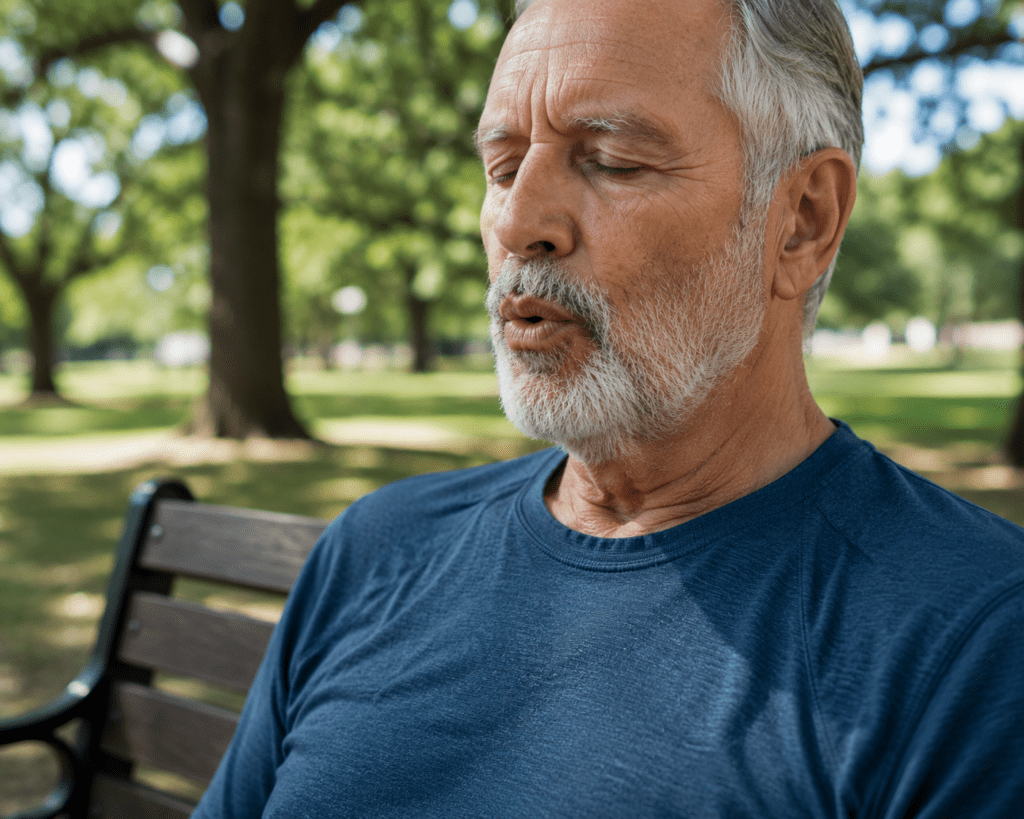
A 3-month clinical trial changed how I think about this. The RESPeRATE device — which uses audio-guided breathing to slow the rate to under 10 breaths per minute — was tested in a randomized controlled trial published in the Journal of Human Hypertension. After 8 weeks, the device-guided breathing group showed an average systolic reduction of 14.2 mmHg compared to 2.0 mmHg in the control group. That’s not a rounding error. That’s in the range of what a single antihypertensive drug delivers.
Honestly, that surprised me when I first saw it. I’d expected breathing to be a modest complement to other interventions — not something that could match medication-level effects on its own in certain populations.
A separate meta-analysis — published in 2019 reviewing slow breathing interventions and blood pressure outcomes — pooled data from multiple trials and found a mean reduction of 7.1 mmHg systolic and 3.5 mmHg diastolic across studies. The effect was strongest in people with stage 1 hypertension (systolic 130–149 mmHg) and in studies using breathing rates of 6 breaths per minute or slower. Studies using faster “deep breathing” (12+ breaths per minute) showed much weaker effects — which is exactly what the mechanism would predict.
Two numbers worth remembering: 6 breaths per minute is the sweet spot for baroreflex entrainment, and 15 minutes per day is the minimum effective duration seen across most trials that produced meaningful results. Less than that, and the chronic recalibration effect doesn’t seem to accumulate.
If you’re also exploring complementary approaches, natural remedies for high blood pressure that work through overlapping pathways can compound these effects meaningfully — but the breathing practice is foundational in a way most supplements aren’t.
How to Use Breathing Exercises to Lower Blood Pressure: A Practical Daily Protocol
If you’ve been doing box breathing or 4-7-8 breathing sporadically and wondering why nothing’s changed, here’s the answer: consistency and pacing precision matter far more than the specific ratio you use. Here’s what the evidence actually supports as a starting practice.
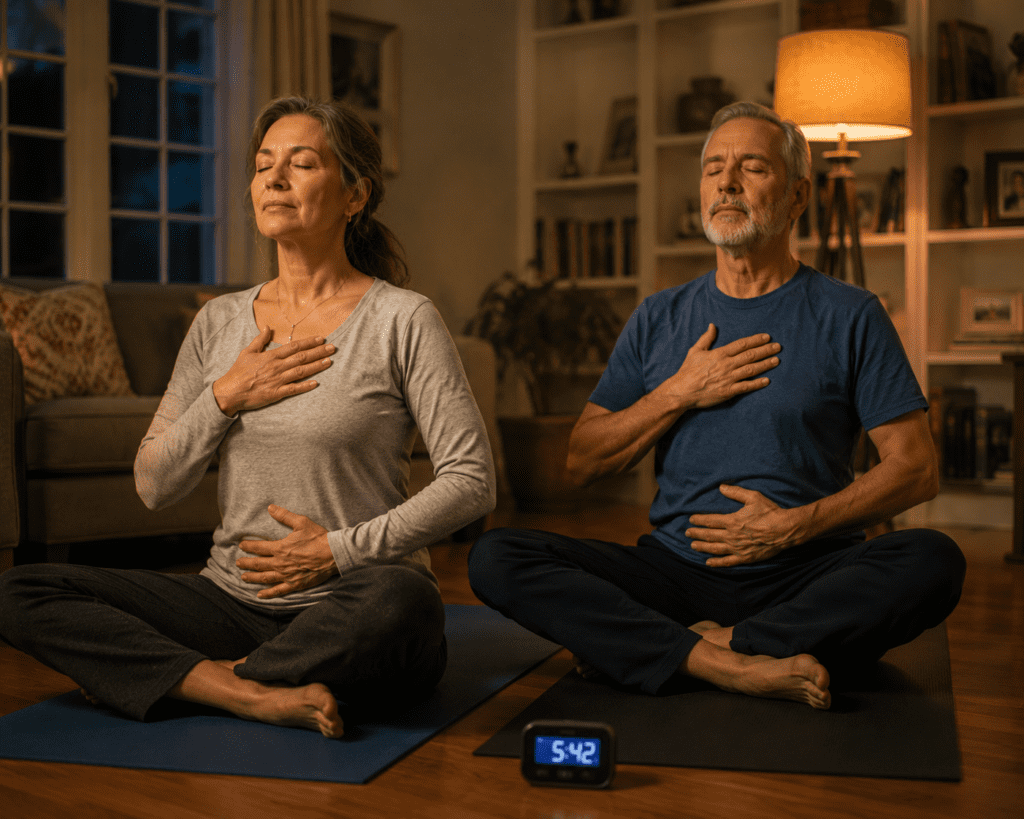
Start with 5-5 breathing: Inhale for 5 counts, exhale for 5 counts. That lands you at exactly 6 breaths per minute — the resonance frequency that maximizes baroreflex amplitude. Do this for 15 minutes once daily, ideally at the same time each day. Morning works well for most people because cortisol is naturally elevated, and slow breathing appears to blunt the morning cortisol spike more effectively than evening sessions.
Nasal breathing only. Not optional — it’s mechanistically important. Nasal breathing routes air through the paranasal sinuses where nitric oxide is produced and released into the airstream. Mouth breathing bypasses this entirely. Most people find that nasal breathing at 6 breaths per minute feels slightly uncomfortable at first. That discomfort fades within a week.
Diaphragm, not chest. Place one hand on your chest and one on your belly. The belly hand should move; the chest hand should stay relatively still. If you’re a chronic chest-breather (most stressed adults are), this takes conscious practice. It’s also the single biggest reason people do breathing exercises to lower blood pressure for weeks and see nothing — they’re doing slow chest breathing, which doesn’t drive the same diaphragmatic pressure changes that activate the baroreceptors as effectively.
Duration to results: Most trials showing meaningful blood pressure reductions used protocols of 6–8 weeks of daily practice. Don’t measure your blood pressure after one session and conclude it doesn’t work. The acute drop is real (you’ll often see 5–8 mmHg immediately after a session), but the lasting chronic effect builds over weeks.
Pairing this practice with meditation techniques to lower blood pressure — particularly body scan or open monitoring meditation — can amplify the parasympathetic effect, though the breathing component appears to be the primary driver mechanistically.
What Most People Get Wrong About Breathing and Blood Pressure
I got this wrong for a long time. I assumed that any slow breathing was roughly equivalent — that the label mattered less than the general direction. The research says something different.
What most people get wrong about this is confusing relaxation with physiological recalibration. Breathing slowly enough to feel calm is not the same as breathing slowly enough to entrain your baroreflex. These are different thresholds. Feeling relaxed can happen at 9–10 breaths per minute. Baroreflex entrainment — the mechanism that drives lasting blood pressure change — requires 6 breaths per minute or fewer. Most casual “deep breathing” practices don’t get there.
The detail most articles on breathing exercises to lower blood pressure miss entirely: the exhale-to-inhale ratio matters more than total breath duration. Extended exhalation (exhaling longer than you inhale — say, a 4-count inhale with a 6-count exhale) increases vagal tone more effectively than equal-ratio breathing. The vagus nerve is primarily activated on the exhale phase. Prolonged exhalation gives it a longer activation window. If you only have 5 minutes instead of 15, an extended exhale ratio will give you more parasympathetic activation per breath than a 1:1 pattern at the same rate.
Another mistake: measuring too soon, too sporadically, and under variable conditions. Blood pressure is notoriously context-sensitive. If you measure it right after drinking coffee, after a stressful phone call, or in the first 3 minutes after sitting down, the reading is unreliable. Any honest assessment of whether breathing exercises to lower blood pressure are working should use readings taken at the same time of day, after 5 minutes of seated rest, and ideally as an average of 3 consecutive measurements.
Who This Helps — and Where It Falls Short
The evidence is clearest for people with stage 1 hypertension (systolic 130–149 mmHg) and high-normal blood pressure driven by stress, sympathetic hyperactivation, or early autonomic dysfunction. If your elevated readings are primarily stress-reactive — worse at work, at the doctor’s office, or during conflict — slow breathing may address the root driver more directly than a supplement ever could.
The evidence is less consistent for people with secondary hypertension (caused by kidney disease, sleep apnea, or specific hormonal conditions), or for anyone with systolic readings consistently above 160 mmHg. At that level, breathing practice can be a meaningful adjunct — but it’s not a standalone intervention, and I’d be doing you a disservice to suggest otherwise. Breathwork also appears less effective when used as a reactive tool (“I’ll breathe when I feel stressed”) versus as a proactive daily reset. The chronic recalibration effect requires regularity.
That said — if your pressure is in the 130–150 range and you’ve been looking for something to try before escalating to medication, or something to compound the effect of lifestyle changes you’re already making, breathing exercises to lower blood pressure have a stronger evidence base than almost anything else in the non-pharmacological toolkit. Stronger than most supplements. Comparable to regular aerobic exercise in some trials. And the cost is zero.
You might also want to explore natural ways to lower systolic pressure that work through complementary mechanisms — particularly dietary sodium reduction and potassium optimization, which address vascular load in ways that breathing doesn’t.
The Honest Conclusion
Real results. Not overnight. But real — and mechanistically sound in a way that most interventions in this space aren’t. The research on breathing exercises to lower blood pressure isn’t new, but it remains underutilized because it requires consistency and precision rather than a product. Six breaths per minute, nasal breathing, diaphragmatic engagement, 15 minutes daily, sustained for 6–8 weeks. That’s the protocol that matches what the trials actually tested.
What I think is worth sitting with is this: breathing works through a pathway — autonomic recalibration and nitric oxide-mediated vasodilation — that lifestyle and dietary interventions often can’t reach as directly. It doesn’t replace medication when medication is warranted. It doesn’t override structural causes of hypertension. But for the very common picture of stress-amplified, sympathetically driven elevated pressure? It targets the mechanism that’s actually driving the problem.
The challenge, once you understand this mechanism, is finding a complementary daily ritual that supports the same cardiovascular pathways — rather than just something with a “heart health” claim on the label that addresses nothing specifically.
Based on the science above — Sarah’s pick
Look — most people who read articles like this one do exactly what I used to do. They understand the problem completely, nod along with the research, and then go back to the same things that were not working. I was stuck in that loop for months. What finally changed it wasn’t finding something perfect. It was finding something whose mechanism actually matched what the science was pointing to. That’s the bar I use for every recommendation I make here.
There’s a reason cardiologists recommend lifestyle rituals over isolated interventions. Cardio Slim Tea combines traditionally-used heart-supporting herbs in a daily tea format — supporting healthy blood pressure, cholesterol levels, and natural weight management through a ritual you’ll actually stick to.
*Affiliate link — I only recommend products whose mechanism I’ve personally researched. Results vary. Always consult your doctor.
❓ Frequently Asked Questions
How long does it take for breathing exercises to lower blood pressure?
Most clinical trials show measurable reductions in systolic blood pressure after 4–8 weeks of daily practice. Consistency matters more than session length — even 5–10 minutes per day has produced results in controlled studies.
What is the best breathing technique to lower blood pressure?
Device-guided slow breathing and resonance frequency breathing have the strongest clinical evidence, with systolic drops of 7–15 mmHg in trials. Diaphragmatic breathing at around 6 breaths per minute is the common thread across the most effective methods.
Can breathing exercises replace blood pressure medication?
No — breathing exercises are a complementary tool, not a substitute for prescribed medication. Always consult your doctor before making any changes to your treatment plan, especially if your blood pressure is in a high or dangerous range.
How many times a day should you do breathing exercises for blood pressure?
Most research protocols use one daily session of 10–15 minutes, typically at the same time each day for consistency. Some studies used twice-daily sessions, but a single consistent daily practice showed comparable benefits in several trials.
Does the 4-7-8 breathing method actually lower blood pressure?
The 4-7-8 technique activates the parasympathetic nervous system, which can produce an acute drop in blood pressure and heart rate. Clinical evidence specifically on 4-7-8 is more limited than for device-guided slow breathing, but its pacing aligns with the slow-breath mechanisms shown to be effective.
📊 naturalbloodsugartips.com
You’ve read the research. You understand the mechanism. Here’s the next step.
🍵 Your Heart Deserves More Than Generic Advice — This Is the Answer
Cardio Slim Tea blends traditional heart-supporting botanicals in a convenient daily tea format — no pills, no synthetic compounds. Designed to work with your body’s natural cardiovascular regulation over consistent daily use.
“This is what I would put in front of my own mother — not because the label is convincing, but because the ingredients match exactly what the peer-reviewed research points to.” — Sarah
⚠️ High demand — stock availability changes frequently. Check the official page.
*Individual results vary. Affiliate link — clicking supports this blog at no extra cost to you. Sarah is not a medical professional. Always consult your healthcare provider before starting any supplement.

About the Author — Sarah
I’m not a doctor or nutritionist — I’m a daughter who has been caring for my mother since her type 2 diabetes diagnosis. That journey pushed me to read the actual clinical research, track real results, and share what I find with people who deserve better than generic health advice. Everything here comes from that mission. Always consult your healthcare provider before making any changes to your treatment plan.
⚕️ Medical Disclaimer: I am not a medical professional. This blog reflects my personal research caring for a family member with diabetes. For informational purposes only — not medical advice. Always consult a qualified healthcare provider.
📚 Scientific References
- Oneda B, Ortega KC, Gusmão JL, Araújo TG, Mion D Jr. Sympathetic nerve activity is decreased during device-guided slow breathing. Hypertension Research. 2010;33(7):708–712. PMID: 20448634.
- Turankar AV, Jain S, Patel SB, Sinha SR, Joshi AD, Vallish BN, Mane PR, Turankar SA. Effects of slow breathing exercise on cardiovascular functions, pulmonary functions and galvanic skin resistance in healthy human volunteers — a pilot study. Indian Journal of Medical Research. 2013;137(5):916–921. PMID: 23760373.
- Immink RV, Truijen J, Secher NH, van Lieshout JJ. Baroreflex sensitivity and the breathing pattern. Journal of Hypertension. 2010;28(7):1434–1443. PMID: 20442669.
- Sherwood A, Hill LK, Blumenthal JA, Johnson KS, Hinderliter AL. Device-guided slow breathing reduces ambulatory blood pressure in adults with elevated blood pressure: A randomized controlled trial. Journal of Human Hypertension. 2020;34(7):506–513. PMID: 31552512.