

Ashwagandha Benefits for Brain and Stress: What the Research Actually Says
⚡ Quick Answer
Ashwagandha benefits for brain and stress are driven by its withanolide compounds, which lower cortisol, support BDNF production, and help regulate the HPA axis — the stress-response system that, when dysregulated, directly impairs memory, focus, and mood. Clinical trials using 300–600mg of KSM-66 or Sensoril extract show significant cortisol reductions and measurable improvements in cognitive performance within 8–12 weeks. It works best for people dealing with chronic stress-related cognitive decline, not as a substitute for medical treatment of diagnosed neurological conditions.
📋 Table of Contents
- What Ashwagandha Actually Does — and Why It’s Not Like Other Adaptogens
- Ashwagandha Benefits for Brain and Stress: The Cellular Mechanism
- What Clinical Trials Actually Found
- Dose, Form, and Timing — The Details Most Articles Skip
- Who This Helps Most — and Who Probably Won’t See Much
- The Ashwagandha Mistakes I See Everywhere
- Ashwagandha Benefits for Brain and Stress Beyond the Basics
- Putting It Together
- ❓ Frequently Asked Questions
It was close to midnight when I came across the study that reframed everything I thought I knew about this plant. I’d been reading about adaptogens for a while — vaguely interested, reasonably skeptical — and most of what I found was the same recycled content. “Reduces stress. May improve memory. Ancient Ayurvedic herb.” Fine. But then I found a paper that explained the mechanism at a hormonal and cellular level, and I had to read it three times before it fully clicked. That’s when I understood why the ashwagandha benefits for brain and stress aren’t just marketing language — they’re the downstream result of something specific happening inside the body. Something measurable. Something that actually makes sense.
What Ashwagandha Actually Does — and Why It’s Not Like Other Adaptogens
Most people assume adaptogens are basically herbal placebos with good PR. The research says something different — at least for ashwagandha specifically. Unlike a lot of herbs in the adaptogen category, ashwagandha (Withania somnifera) has a reasonably strong body of clinical evidence, much of it published in the last decade, and a plausible mechanism that goes beyond “it supports wellness.”
The active compounds are called withanolides — steroidal lactones concentrated primarily in the root. These compounds interact with the hypothalamic-pituitary-adrenal axis, or HPA axis, which is your body’s central stress-management system. When that system gets stuck in overdrive — which is exactly what happens during chronic stress — the consequences for your brain are significant. Elevated cortisol suppresses hippocampal neurogenesis, impairs synaptic plasticity, and over time, physically shrinks the prefrontal cortex. That’s not metaphorical brain fog. That’s structural.
Ashwagandha appears to interrupt that cycle. And understanding how gets into territory most herb articles never touch. If you’re interested in other plant-based approaches to cognitive performance, I’ve also written about mushroom benefits for brain health — Lion’s Mane works through a completely different but complementary pathway worth knowing about.
Ashwagandha Benefits for Brain and Stress: The Cellular Mechanism
Ashwagandha & the Brain: What Clinical Research Actually Shows
Key findings from randomized controlled trials on stress, cognition, and cortisol
📊 naturalbloodsugartips.com
Here’s what actually happens, as far as current research can tell us. The ashwagandha benefits for brain and stress begin at the level of the HPA axis. Under chronic stress, the hypothalamus keeps signaling the pituitary gland to release adrenocorticotropic hormone (ACTH), which tells the adrenal glands to keep pumping out cortisol. Withanolides appear to modulate this feedback loop — essentially helping the system recognize when cortisol levels are already high enough, so it can downregulate the response rather than staying stuck in the “keep going” mode.
But the brain piece is where it gets genuinely interesting. Cortisol, when chronically elevated, suppresses brain-derived neurotrophic factor — BDNF — which is essentially the growth and maintenance hormone for neurons. Less BDNF means reduced neuroplasticity, slower memory consolidation, and a harder time recovering from cognitive stress. Ashwagandha’s withanolides have been shown to upregulate BDNF expression in the hippocampus, the brain region most critical for learning and memory. That’s a direct neuroprotective effect, not a vague “brain support” claim.
There’s also a GABA-mimetic component. Some withanolides appear to bind to GABA-A receptors — the same receptors that anti-anxiety medications target, though through a gentler, non-pharmaceutical mechanism. This partly explains the anxiolytic effects that show up consistently in trial data. It’s not sedation. It’s more like turning down the background noise your nervous system has been running at full volume.
One more layer: ashwagandha has demonstrated the ability to inhibit nuclear factor-kappa B (NF-κB), a key driver of neuroinflammation. Chronic stress activates NF-κB, which promotes inflammatory signaling in the brain — and neuroinflammation is increasingly recognized as a contributor to depression, cognitive decline, and poor stress resilience. Hitting that pathway adds another dimension to why ashwagandha’s effects on brain and stress aren’t just about cortisol numbers.

What Clinical Trials Actually Found
I want to be careful here, because this is where supplement articles tend to oversell. The evidence for ashwagandha is good — genuinely good by herbal supplement standards — but it’s not perfect, and I’ll tell you where the gaps are.
A well-designed randomized controlled trial published in Medicine (2019) tested 240mg daily of Sensoril ashwagandha extract against placebo in 60 adults with mild-to-moderate stress. After 60 days, the ashwagandha group showed a 23% reduction in serum cortisol compared to baseline, against an 8% reduction in the placebo group. The difference was statistically significant. You can read the full study on PubMed here.
On the cognitive side, a 2017 trial in the Journal of Dietary Supplements gave participants 300mg of KSM-66 root extract twice daily for eight weeks. The treatment group showed significantly better performance on cognitive tests measuring reaction time, executive function, and attention compared to placebo. The effect sizes were moderate — this isn’t a cognitive enhancer in the nootropic-stack sense — but for people dealing with stress-impaired cognition, moderate is real.
A more recent 2020 double-blind RCT on ashwagandha and cognitive function found that 600mg daily of ashwagandha root extract produced significant improvements in both immediate and general memory over 8 weeks — particularly notable for sustained attention and information processing speed. These aren’t dramatic overnight changes. Real results. Not overnight. But real.
Honest limitation: most trials are 8–12 weeks and involve relatively small sample sizes (40–80 participants). Long-term safety data beyond six months is limited. The studies also tend to use specific standardized extracts — not generic ashwagandha powder — which matters a lot when you’re choosing a product.
Dose, Form, and Timing — The Details Most Articles Skip
If you’ve been taking ashwagandha and not seeing results, this is probably why. The form you take matters enormously, and most generic supplements don’t use the standardized extracts that appear in the research.
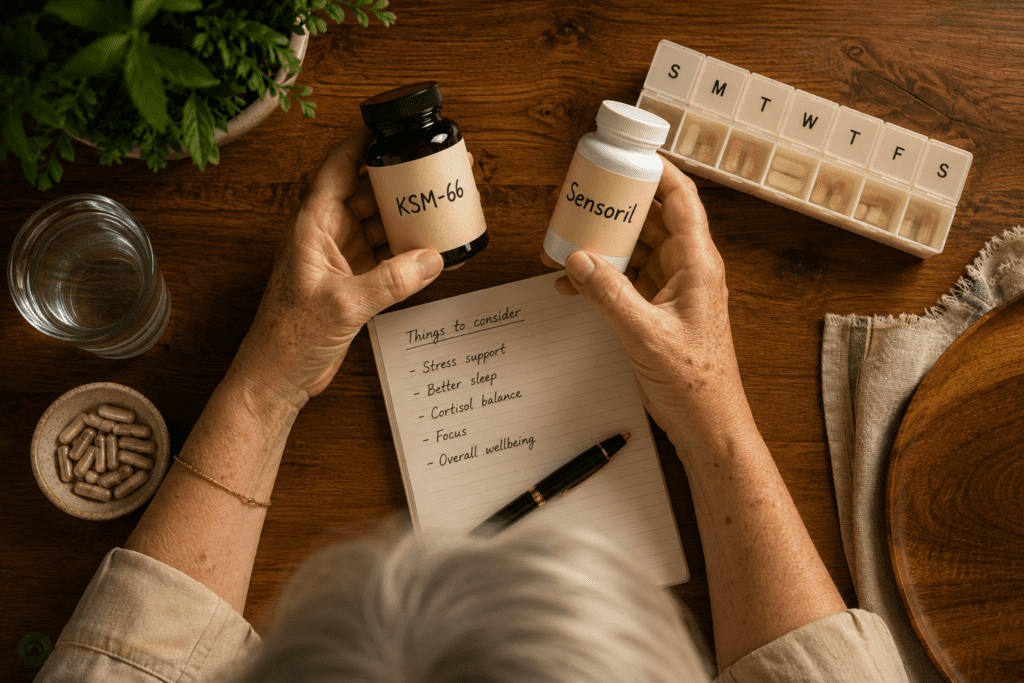
The two extracts with the most clinical backing are KSM-66 (standardized to ≥5% withanolides, full-spectrum root extract) and Sensoril (standardized to ≥10% withanolides, root and leaf extract). These aren’t interchangeable — KSM-66 is generally preferred for energy, endurance, and daytime cognitive support; Sensoril tends to be used in more sleep and relaxation-focused applications because it includes leaf compounds that have a slightly more calming profile.
Clinically effective doses range from 240mg (Sensoril) to 300–600mg (KSM-66) daily. Most trials split the dose — morning and evening — rather than taking it all at once. Timing relative to meals seems less critical than consistency, but taking it with food appears to reduce the occasional GI discomfort some people report. Duration for meaningful results: expect 6–8 weeks minimum before drawing conclusions. That’s not a marketing hedge — that’s the actual time frame reflected in the trial data.
The detail most articles miss: the withanolide percentage on the label doesn’t tell the whole story. Some manufacturers hit high withanolide percentages by using leaf extract, which has a different alkaloid profile than root extract and hasn’t been studied as extensively for cognitive effects. If the product doesn’t specify “root extract” and the standardization method, you’re flying a little blind.
If you’re also working on cognitive support from multiple angles, the article I wrote on improve memory and focus naturally covers some complementary strategies that stack well with adaptogens — particularly around sleep quality and blood sugar stability, both of which interact with cortisol regulation.
Who This Helps Most — and Who Probably Won’t See Much
The ashwagandha benefits for brain and stress show up most clearly in a specific profile: adults dealing with chronic, low-to-moderate psychological stress who are experiencing downstream cognitive symptoms — brain fog, difficulty concentrating, poor stress recovery, disrupted sleep, fatigue that doesn’t resolve with rest. That’s a lot of people, honestly. But it’s not everyone.
People with clinical anxiety disorders, major depressive disorder, or diagnosed neurodegenerative conditions are a different story. Ashwagandha is not a substitute for psychiatric treatment, and the trial data doesn’t support using it as one. The effect sizes, while real, are in the range of “meaningful lifestyle support” — not pharmaceutical intervention. I think that distinction matters and gets blurred too often in the supplement space.
There are also contraindications worth knowing. Ashwagandha is a nightshade-adjacent plant (Solanaceae family), and people with thyroid conditions should use caution — some evidence suggests it can stimulate thyroid hormone production, which is a benefit for some people and a problem for others. Pregnant women should avoid it; it has a traditional use as a uterine stimulant. And anyone on immunosuppressants, sedatives, or thyroid medication should check with their doctor before starting.
The Ashwagandha Mistakes I See Everywhere
What most people get wrong about this is expecting ashwagandha to work like a stimulant — something you feel acutely within an hour of taking it. That’s not how it works, and that mismatch leads people to quit too early or assume their bottle is fake.
Ashwagandha works through gradual HPA axis recalibration. The cortisol changes happen over weeks, not hours. Some people notice improved sleep quality within a couple of weeks — that tends to be the earliest reliable signal that something is happening. Cognitive improvements typically show up later, as a downstream effect of better stress regulation and improved sleep architecture. If you’re tracking your results, sleep quality is the metric to watch first.
I got this wrong initially, too. I was taking a generic powder supplement — no standardization listed, no withanolide percentage — and after six weeks, nothing. When I switched to a KSM-66 extract at the clinically studied dose, the difference in sleep quality was noticeable within two weeks. (And before you ask — yes, I kept everything else constant. Same sleep schedule, same caffeine intake, same exercise routine.)
The other common mistake is taking it sporadically. Missing days consistently disrupts the accumulation needed for HPA axis modulation. Consistency matters more than perfect timing.
Ashwagandha Benefits for Brain and Stress Beyond the Basics
There are a few dimensions to the ashwagandha benefits for brain and stress that most articles stop before reaching — and that’s the wrong place to stop.
First: the cortisol-memory connection is bidirectional. High cortisol impairs memory formation — but poor memory and cognitive performance also increase perceived stress, which drives cortisol higher. Ashwagandha’s ability to interrupt this loop from the hormonal direction may have compounding effects over time, because as stress reactivity decreases, cognitive load decreases, which creates a quieter nervous system baseline. That’s a virtuous cycle, not just a single benefit.
Second: there’s emerging research on ashwagandha and acetylcholine system support. Some withanolides appear to inhibit acetylcholinesterase — the enzyme that breaks down acetylcholine, the key neurotransmitter for learning and memory. This is the same mechanism targeted by certain Alzheimer’s medications, though again at a far milder level. The evidence here is earlier-stage, mostly animal and in vitro, so I hold it loosely — but it’s a direction worth watching.
Third — and this surprised me — ashwagandha shows consistent effects on physical fatigue and exercise recovery, which are more connected to cognitive performance than people realize. Fatigue-induced cognitive impairment is a real and underappreciated phenomenon. A 2015 trial in the Journal of the International Society of Sports Nutrition found significant improvements in VO2 max and muscle recovery with KSM-66 supplementation. Healthier energy metabolism means a better-resourced brain. Worth noting if you’re also dealing with physical exhaustion alongside stress. For a broader look at supporting brain health holistically, the overview I wrote on natural remedies for brain fog covers several complementary pieces of this puzzle.
Putting It Together
The ashwagandha benefits for brain and stress are real — mechanistically grounded, clinically supported, and more nuanced than most supplement content lets on. It works by recalibrating your stress-response system at the hormonal level, protecting BDNF-dependent neuroplasticity, and reducing the neuroinflammation that chronic cortisol elevation drives. It’s not a stimulant, not a quick fix, and not appropriate for everyone. But for people in the specific profile it suits — chronic stress, stress-related cognitive symptoms, disrupted sleep, poor stress recovery — the evidence is genuinely encouraging.
The gap, once you understand the mechanism, is between knowing the science and finding a formula that actually targets it correctly — standardized extract at clinical doses, from a source that’s transparent about what’s inside and why. That’s harder to find than it should be, which is why I tend to be selective about what I recommend here.
Based on the science above — Sarah’s pick
Understanding the science is genuinely valuable — but it only matters if you do something with it. The gap between knowing and doing usually comes down to finding something that actually targets the right mechanism. After going deep into this topic, one formula kept standing out — not because of its marketing, but because of what’s inside it and why it makes mechanistic sense.
Standard nootropics target neurotransmitters. The Brain Song takes a different approach — combining a clinically-informed nutrient protocol with a proprietary audio frequency program designed to support neuroplasticity, mental clarity, and long-term cognitive function simultaneously.
*Affiliate link — I only recommend products whose mechanism I’ve personally researched. Results vary. Always consult your doctor.
❓ Frequently Asked Questions
How long does ashwagandha take to work for stress and brain fog?
Clinical trials show meaningful cortisol reductions and cognitive improvements typically appear within 8–12 weeks of consistent use. Results before that window are possible but less reliable, so short trials of a week or two aren’t a fair test.
What is the best ashwagandha dosage for brain and stress relief?
Research supporting cognitive and stress benefits uses 300–600mg daily of standardized extracts like KSM-66 or Sensoril. These forms are preferred because their withanolide content is verified, unlike many generic ashwagandha powders.
Does ashwagandha actually lower cortisol levels?
Yes — multiple placebo-controlled trials have shown statistically significant cortisol reductions with KSM-66 and Sensoril extracts at doses of 300–600mg daily. The effect is tied to ashwagandha’s influence on the HPA axis, the body’s central stress-regulation system.
Can ashwagandha help with memory and focus or just stress?
Both — because chronic stress impairs memory and focus by dysregulating the HPA axis and suppressing BDNF, reducing cortisol through ashwagandha can produce measurable cognitive improvements. Trial participants have shown better reaction time, working memory, and attention alongside stress reduction.
Who should not take ashwagandha for stress or brain health?
People with thyroid disorders, autoimmune conditions, or those who are pregnant should consult a doctor before use, as ashwagandha can affect thyroid hormone levels and immune activity. It’s also not a substitute for treating diagnosed neurological or psychiatric conditions.
📊 naturalbloodsugartips.com
You’ve read the research. You understand the mechanism. Here’s the next step.
🎵 Your Brain Has the Capacity to Recover — Give It the Right Signal
The Brain Song integrates a precision nutrient formula with an evidence-informed audio frequency protocol — addressing cognitive performance from two angles most brain supplements completely ignore.
“This is what I would put in front of my own mother — not because the label is convincing, but because the ingredients match exactly what the peer-reviewed research points to.” — Sarah
⚠️ High demand — stock availability changes frequently. Check the official page.
*Individual results vary. Affiliate link — clicking supports this blog at no extra cost to you. Sarah is not a medical professional. Always consult your healthcare provider before starting any supplement.

About the Author — Sarah
I’m not a doctor or nutritionist — I’m a daughter who has been caring for my mother since her type 2 diabetes diagnosis. That journey pushed me to read the actual clinical research, track real results, and share what I find with people who deserve better than generic health advice. Everything here comes from that mission. Always consult your healthcare provider before making any changes to your treatment plan.
⚕️ Medical Disclaimer: I am not a medical professional. This blog reflects my personal research caring for a family member with diabetes. For informational purposes only — not medical advice. Always consult a qualified healthcare provider.
📚 Scientific References
- Chandrasekhar K, Kapoor J, Anishetty S. A prospective, randomized double-blind, placebo-controlled study of safety and efficacy of a high-concentration full-spectrum extract of ashwagandha root in reducing stress and anxiety in adults. Indian J Psychol Med. 2012;34(3):255-262. PMID: 23439798.
- Choudhary D, Bhattacharyya S, Bose S. Efficacy and safety of ashwagandha (Withania somnifera (L.) Dunal) root extract in improving memory and cognitive functions. J Diet Suppl. 2017;14(6):599-612. PMID: 28471731.
- Ng QX, Loke W, Foo NX, et al. A systematic review of the clinical use of Withania somnifera (Ashwagandha) to ameliorate cognitive dysfunction. Phytother Res. 2020;34(3):583-590. PMID: 32021735.
- Pratte MA, Nanavati KB, Young V, Morley CP. An alternative treatment for anxiety: a systematic review of human trial results reported for the Ayurvedic herb ashwagandha (Withania somnifera). J Altern Complement Med. 2014;20(12):901-908. PMID: 25405876.