
How to Improve Memory and Focus Naturally After 40: What I Learned From Watching My Mom
📋 Table of Contents
I still remember the afternoon my mom stood in her own kitchen, holding a wooden spoon, and completely forgot why she’d walked in there. She laughed it off — “senior moment,” she said — but I saw something flicker behind her eyes that wasn’t quite a joke. She was 54. And honestly? I was 41, and I’d been having my own version of those moments. Keys on top of the fridge. Names gone mid-sentence. A grocery list I swore I’d memorized, completely blank by the time I hit the store. That’s when I started digging into how to improve memory and focus naturally, not just for her, but for both of us.

What I found surprised me — and gave me a lot of hope. The brain isn’t just along for the ride after 40. It’s incredibly responsive to the right inputs. And there are real, research-supported ways to sharpen things back up without immediately reaching for a prescription pad.
My mom already had her hands full managing type 2 diabetes, and I was careful not to pile on anything that might interfere with her care plan. But what I discovered was that many of the natural approaches that support blood sugar stability also happen to support brain health — which made our journey together feel a little less overwhelming and a lot more connected.
I’m not a doctor. I want to be clear about that upfront. Everything I share here comes from personal research, conversations with her healthcare team, and what we actually tried in real life. Some things didn’t move the needle. Others felt like turning on a light in a dim room. I’m going to share the ones that genuinely worked for us.
If you’ve been dealing with brain fog, forgetfulness, or that frustrating inability to stay on task, you’re not imagining it — and you’re definitely not alone. The good news is that small, consistent changes can make a meaningful difference. Let me walk you through what I learned.
🧠 Clear the Fog — Try The Brain Song
An increasing number of people dealing with brain fog and memory lapses are discovering The Brain Song — a unique cognitive support program that combines targeted nutrients with a science-backed auditory approach to mental clarity.
Check Availability Inside the US →Why Memory and Focus Change After 40
Here’s what I didn’t realize at first: the brain changes we feel after 40 are real, biological, and incredibly common — but they’re also not inevitable in their severity. After 40, estrogen and testosterone levels begin shifting, and both hormones play a role in how neurons communicate. Blood flow to the brain can slow slightly. Cortisol from chronic stress — and let’s be honest, most of us in midlife have plenty of that — literally affects the hippocampus, the region most responsible for forming new memories.
For my mom, blood sugar instability added another layer. Glucose spikes and crashes can leave the brain starved for steady fuel, which shows up as fogginess, fatigue, and trouble concentrating. I started connecting dots between her cognitive dips and what she’d eaten a couple of hours earlier. That connection became one of our most useful tools.
Understanding the “why” helped us stop blaming ourselves and start problem-solving. The brain isn’t broken — it’s asking for something different.
Natural Ways to Improve Memory and Focus Naturally Every Day
Boost Memory & Focus Naturally After 40
Consult a healthcare provider before making significant lifestyle changes, especially if managing existing health conditions.
📊 naturalbloodsugartips.com
Once I understood what was actually happening physiologically, I was able to approach the question of how to improve memory and focus naturally with a lot more clarity. The strategies that consistently came up in credible research — and that we personally tested — fell into a few key categories. If you’re looking for deeper context on why foggy thinking happens and how to approach it holistically, this piece on natural remedies for brain fog filled in a lot of gaps for me early on.
- Morning movement: Even a 20-minute walk increased my mom’s alertness for hours afterward. Research consistently links aerobic exercise to increased BDNF — a protein that supports neuron growth and connectivity.
- Strategic hydration: Mild dehydration — even 1-2% — measurably impairs short-term memory and attention. We started front-loading water in the mornings and noticed a difference within days.
- Consistent sleep schedule: Memory consolidation happens during sleep, especially in the deeper stages. We became almost strict about a consistent bedtime, which felt boring but absolutely helped.
- Mindful breaks: Working or thinking in long, unbroken stretches actually degrades focus. Short breaks every 45-90 minutes helped both of us stay sharper through the day.
None of these cost anything. That matters — especially when you’re already managing a health condition and watching the budget for supplements and specialists.
Foods and Herbs That Actually Made a Difference
I was skeptical about supplements at first. But I kept coming back to the same handful of nutrients in the research, and once we started being more deliberate about food, the results were noticeable. Here’s what moved the needle for us.
- Omega-3 fatty acids: Found in fatty fish like salmon and sardines, omega-3s — especially DHA — are directly incorporated into brain cell membranes. We started eating salmon twice a week, and my mom’s afternoon mental fog became less predictable and less severe.
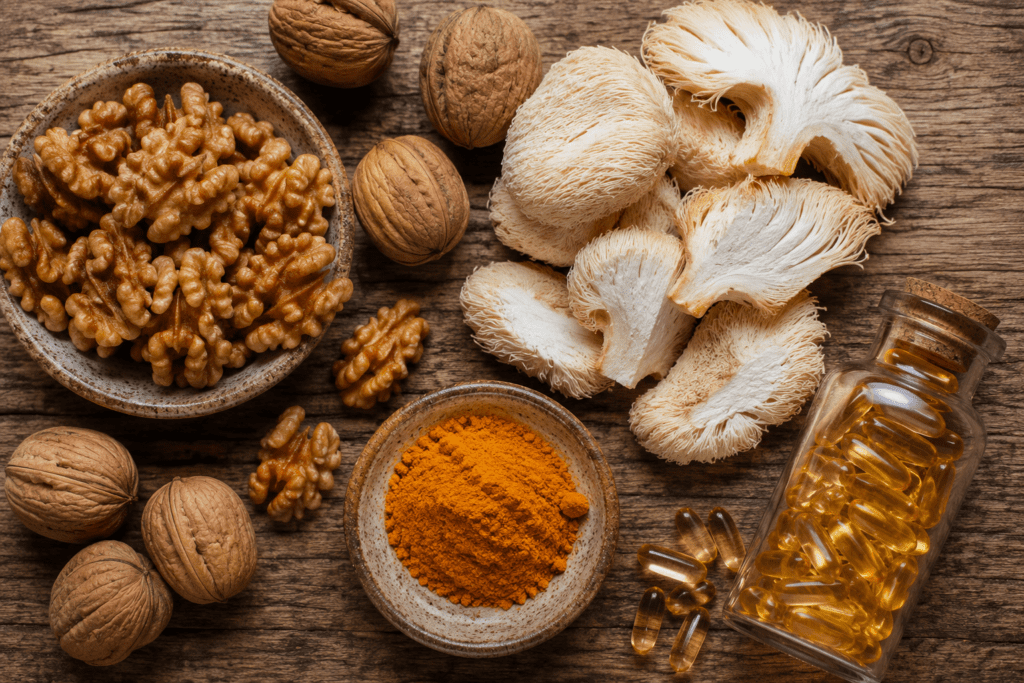
- Lion’s Mane mushroom: I was honestly surprised by this one. Lion’s Mane has shown promise in studies for supporting nerve growth factor. We added it in supplement form and noticed my mom felt mentally clearer after a few weeks of consistent use.
- Blueberries: Anthocyanins in blueberries cross the blood-brain barrier and have been associated with improved memory in older adults. We started adding a handful to her morning yogurt daily.
- Magnesium: Many Americans are deficient. Magnesium plays a role in over 300 enzymatic reactions, including those that regulate neurotransmitter function. Dark leafy greens, pumpkin seeds, and a magnesium glycinate supplement became regulars for us.
We also leaned into warm beverages in the afternoon — not just for comfort, but because certain herbal teas that support brain health showed up consistently in my research as gentle cognitive allies. Ginkgo biloba tea and green tea with L-theanine became afternoon rituals that I genuinely looked forward to.
Simple Lifestyle Habits to Improve Memory and Focus Naturally
The lifestyle piece is where I think most people — myself included — underestimate the impact. I spent months reading about supplements before I really committed to the unsexy foundational stuff. When we finally did, the cumulative effect was bigger than any single thing we tried.
- Stress management: Chronic stress is one of the most damaging things for the aging brain. We started a simple 5-minute breathing practice after dinner — nothing elaborate, just diaphragmatic breathing — and it noticeably softened the evening mental exhaustion both of us experienced.
- Social engagement: I didn’t expect this one to matter so much, but research is clear: regular meaningful social interaction protects cognitive function. We made weekly phone calls to family non-negotiable.
- Learning something new: My mom started a simple jigsaw puzzle habit. I started learning guitar — badly, but enthusiastically. Novel mental challenges strengthen neural pathways in ways that routine tasks simply don’t.
- Reducing processed sugar: This one hit differently once I saw how her blood sugar spikes correlated with her foggy hours. Stabilizing blood glucose is one of the most direct ways to support consistent brain fuel. It’s also one reason I found the world of natural metabolism boosters after 50 so relevant to cognitive health — the connection runs deeper than most people realize.

What We Still Do Every Single Day
A few years into this journey, what I can tell you is that consistency is everything. The individual strategies matter less than the habit of doing them regularly. My mom still has moments — we both do. But those moments are rarer, shorter, and less distressing than they used to be. She walks in the mornings. She eats salmon on Wednesdays and Saturdays. She drinks her afternoon herbal tea and does her puzzles. And she sleeps at roughly the same time every night.
For me personally, committing to daily omega-3s, consistent sleep, and that midday walk has made me feel measurably sharper — not 25 again, but present, capable, and clear in a way that felt genuinely lost for a couple of years there.
The truth about how to improve memory and focus naturally isn’t a secret. It’s not hiding in an expensive supplement or a complex protocol. It’s in the unglamorous accumulation of small, supportive choices that tell your brain: I’m taking care of you. And your brain — this extraordinary, adaptable, resilient organ — responds. I’ve watched it happen. I’ve felt it happen. And I believe it can happen for you, too.
🎵 Give Your Brain the Frequency It’s Been Missing
The Brain Song takes a completely different approach to brain health — combining a carefully formulated supplement with a proprietary audio frequency protocol designed to support memory, focus, and long-term cognitive function.
👉 Claim Your Supply With Free Shipping Today⚠️ Update: Due to high demand, stock is limited. Check availability now.
*Results may vary. Affiliate link.

About the Author — Sarah
I’m not a doctor or nutritionist — I’m a daughter who has been caring for my mother since her type 2 diabetes diagnosis. That journey pushed me to research natural alternatives and evidence-based lifestyle changes. Everything I share comes from that personal mission: to help my mom live better, with more energy and less dependence on medication. Always consult your healthcare provider before making any changes to your treatment plan.
⚕️ Medical Disclaimer: I am not a medical professional. This blog reflects my personal research caring for a family member with diabetes. For informational purposes only — not medical advice. Always consult a qualified healthcare provider.
📚 Scientific References
- Gomez-Pinilla F. Brain foods: the effects of nutrients on brain function. Nature Reviews Neuroscience. 2008;9(7):568-578. PMID: 18568016.
- Erickson KI, Voss MW, Prakash RS, et al. Exercise training increases size of hippocampus and improves memory. Proceedings of the National Academy of Sciences. 2011;108(7):3017-3022. PMID: 21282661.
- Mori K, Inatomi S, Ouchi K, Azumi Y, Tuchida T. Improving effects of the mushroom Yamabushitake (Hericium erinaceus) on mild cognitive impairment: a double-blind placebo-controlled clinical trial. Phytotherapy Research. 2009;23(3):367-372. PMID: 18844328.
- Krikorian R, Shidler MD, Nash TA, et al. Blueberry supplementation improves memory in older adults. Journal of Agricultural and Food Chemistry. 2010;58(7):3996-4000. PMID: 20047325.