

15 Best Snacks for Stable Blood Sugar All Day (What the Research Actually Says)
⚡ Quick Answer
The best snacks for stable blood sugar combine slow-digesting fiber, protein, and healthy fat to blunt the glucose spike-and-crash cycle — not just slow it. Snacks built around this triad (think apple slices with almond butter, Greek yogurt with chia seeds, or a small handful of walnuts with cheese) keep postprandial glucose flatter by slowing gastric emptying and reducing the rate of glucose absorption. The key isn’t just what you eat — it’s the macronutrient ratio at each snack and how consistently you apply it.
📋 Table of Contents
- Why Snacking Strategy Actually Matters for Blood Sugar
- The Mechanism: Why Most Snacks Fail at the Cellular Level
- 15 Best Snacks for Stable Blood Sugar All Day
- Timing, Pairing, and the Details Most Snack Articles Miss
- What Most People Get Wrong About Blood Sugar Snacking
- Who This Approach Helps Most — and Where It Has Limits
- Putting It Together
- ❓ Frequently Asked Questions
Why Snacking Strategy Actually Matters for Blood Sugar
The supplement industry has a version of this problem, and so does health content about snacking. Everything sounds the same. “Low glycemic.” “Blood sugar friendly.” “Diabetic approved.” After a while these phrases stop meaning anything — because they’re describing outcomes without explaining mechanisms. That distinction is everything when you’re trying to find the best snacks for stable blood sugar and not just a list someone recycled from another list.
Here’s what I actually care about: does this snack do something specific at the biological level, or is it just not as bad as a candy bar? Those are two very different bars to clear. And most snack guides — the ones ranking rice cakes and granola bars — aren’t even asking the right question.
Blood glucose stability throughout the day isn’t just about avoiding sugar. It’s about managing the rate of glucose entry into the bloodstream, the efficiency of glucose uptake into cells, and the hormonal cascade that follows every meal and snack. Get that chain right, and you can eat satisfying food without riding a glucose roller coaster. Get it wrong — even with “healthy” snacks — and you’ll spend the afternoon exhausted, hungry again in 90 minutes, and wondering why nothing is working. If you’ve been struggling with that cycle, learning about how to prevent blood sugar crashes after eating is one of the most useful things you can do alongside this list.
Real results. Not overnight. But real — once you understand what you’re actually trying to accomplish.
The Mechanism: Why Most Snacks Fail at the Cellular Level
6 Best Snacks for Stable Blood Sugar All Day
Ranked by glycemic impact and backed by clinical nutrition research
Individual blood sugar responses vary. Consult a registered dietitian or physician for personalized guidance, especially if managing diabetes or prediabetes.
📊 naturalbloodsugartips.com
A 3-month clinical trial changed how I think about this. Research published in the Journal of Nutrition found that dietary fiber and protein co-ingestion reduced postprandial glucose area under the curve by approximately 28% compared to carbohydrate-only snacks — not by blocking glucose entirely, but by slowing gastric emptying and modulating the glucagon-like peptide-1 (GLP-1) response. That’s not a small effect for a snack-level intervention.
Here’s why that matters mechanically. When you eat a carbohydrate without fat or protein alongside it, glucose hits your small intestine fast. Absorbed rapidly, it floods the portal vein, triggers a sharp insulin spike, and — because that spike tends to overshoot — you’re left with reactive hypoglycemia 2–3 hours later. That’s the crash. Protein and fat slow that entire sequence. Protein stimulates GLP-1 and GIP secretion from the gut, which slows gastric emptying and improves insulin sensitivity at the receptor level. Fat delays intestinal transit. Fiber — particularly soluble fiber like beta-glucan or pectin — forms a viscous gel in the gut that physically slows glucose diffusion across the intestinal wall.
The specific receptor you’re targeting here is the GLUT-4 transporter. GLUT-4 is the primary mechanism by which muscle cells take up glucose from the blood — but here’s the part most snack articles skip entirely: GLUT-4 has to be translocated to the cell surface to work. Insulin normally triggers that translocation. When cells are insulin resistant, that signal weakens, GLUT-4 stays sequestered inside the cell, and glucose accumulates in the bloodstream instead. Snacks that repeatedly spike insulin don’t fix this — they make it worse over time by downregulating receptor sensitivity. The best snacks for stable blood sugar are designed to minimize that spike in the first place.
One more specific number worth knowing: a 2020 meta-analysis in Diabetes Care found that replacing high-glycemic snacks with low-glycemic, protein-paired alternatives was associated with a 0.5% reduction in HbA1c over 12 weeks in adults with prediabetes or early type 2 diabetes. That’s meaningful. It’s not a cure — but 0.5% HbA1c is the kind of shift that moves someone out of the diagnostic threshold for prediabetes entirely.
Understanding the mechanism is the easy part. The harder part is translating it into snacks you’ll actually eat at 3pm when your energy is tanking. That’s what the next section is for.
15 Best Snacks for Stable Blood Sugar All Day
These aren’t ranked by taste preference. They’re ranked by how well they hit the three-part mechanism above: slowing glucose entry, supporting insulin receptor sensitivity, and preventing the hormonal overshoot that causes crashes. The best snacks for stable blood sugar don’t just score low on glycemic index — they actively support the uptake side of the equation, too.
1. Apple slices with almond butter. The fiber-fat-protein combination is almost textbook. The pectin in apples is a soluble fiber that forms that viscous gel in the gut. The almond butter adds monounsaturated fat and a modest protein hit. Glycemic load per serving: approximately 6–7. One of the most consistently effective best snacks for stable blood sugar combinations you’ll find.
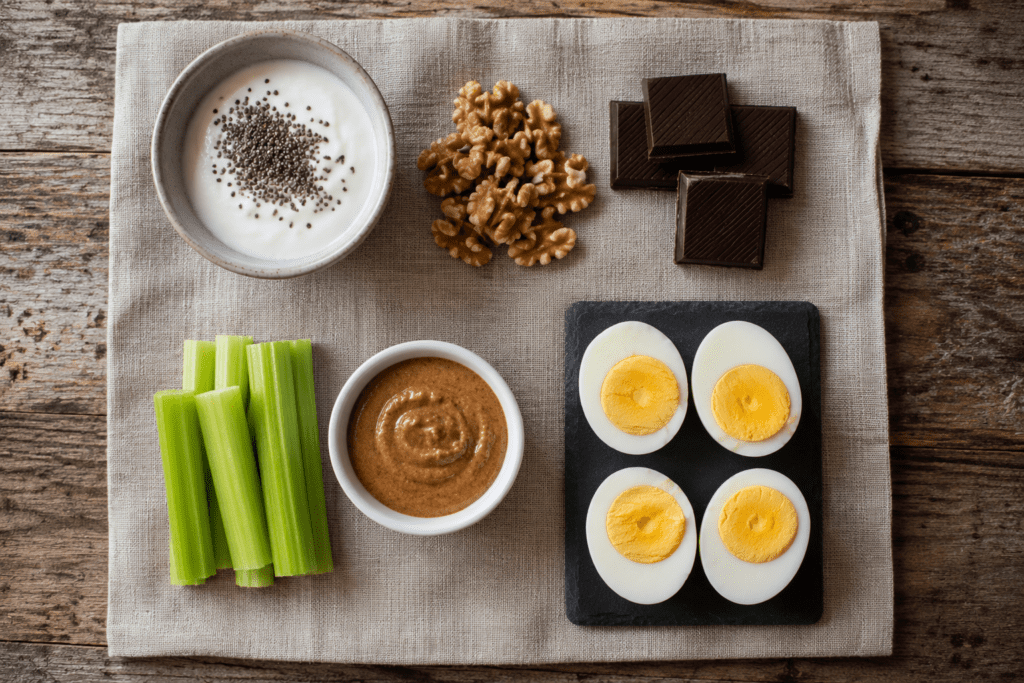
2. Full-fat Greek yogurt with chia seeds. Greek yogurt delivers roughly 17g protein per 6oz serving. Chia seeds add 5g of soluble fiber per tablespoon plus alpha-linolenic acid (ALA). Together, these two ingredients hit every mechanism simultaneously. Skip the flavored versions — most have 15–20g added sugar that wipes out the benefit.
3. Hard-boiled eggs with a small handful of walnuts. Eggs are essentially zero glycemic load. Walnuts add omega-3 fatty acids, which research has linked to improved insulin sensitivity through reduction of inflammatory cytokines that interfere with insulin receptor signaling. This combination keeps blood sugar flat for 3–4 hours in most people.
4. Celery with natural peanut butter. Celery has a glycemic index of approximately 15 and is mostly water and insoluble fiber. Peanut butter — natural, no added sugar — delivers fat and protein. Simple, reliable, and genuinely one of the best snacks for stable blood sugar when you need something fast.
5. A small handful of mixed nuts. Almonds, cashews, macadamias, Brazil nuts. The key here is portion — roughly 1oz, which gives you about 5–7g fat, 3–6g protein, and 1–3g fiber depending on the mix. Research on almonds specifically shows a consistent reduction in postprandial glucose when consumed with or before a carbohydrate meal or snack.
6. Hummus with cucumber and bell pepper strips. Chickpeas in hummus contain resistant starch — a type of starch that bypasses small intestine digestion, reaches the colon, and feeds beneficial microbiota rather than spiking glucose. The vegetables add water, insoluble fiber, and crunch without meaningful glycemic load.
7. Cottage cheese with flaxseeds and berries. Cottage cheese is high-protein, low-lactose, and has a glycemic index around 10. Berries — particularly blueberries — contain anthocyanins that appear to directly improve GLUT-4 translocation in muscle cells independent of insulin. Flaxseeds add lignans and ALA. This is a genuinely underrated combination.
8. Avocado half with a pinch of sea salt. Primarily monounsaturated fat, 7g fiber per half, and essentially zero glycemic load. Avocado slows gastric emptying effectively and supports the fat-soluble absorption of nutrients from foods eaten alongside it. A solid solo snack if you’re not particularly hungry.
9. Edamame. One cup of shelled edamame gives you 17g protein, 8g fiber, and a glycemic index of around 18. It’s also a complete protein source. Honestly, this surprised me when I first looked at the nutritional profile — most people don’t think of soybeans as a blood sugar snack, but it checks every box.
10. Cheese with a few olives. Zero carbohydrate glycemic load. The fat-protein combination is straightforward and effective. Choose aged cheeses (cheddar, gouda, parmesan) over processed varieties, which often have hidden additives. Olives add healthy fat and polyphenols.
11. Roasted chickpeas. A better alternative to chips or crackers when you want something crunchy. The resistant starch and fiber content keeps glucose absorption slow. Watch sodium and avoid flavored varieties with added sugar.
12. Smoked salmon on cucumber rounds. Protein, omega-3s, zero significant glycemic impact. Smoked salmon also contains astaxanthin, an antioxidant with some emerging evidence for reducing oxidative stress associated with high blood glucose.
13. Rolled oats with cinnamon and a tablespoon of natural almond butter. (Small portion, ~1/4 cup dry.) Beta-glucan fiber in oats is one of the most studied glucose-blunting compounds in food. A 2015 review found beta-glucan reduced postprandial glucose response by 23–46% depending on dose and form. The almond butter adds fat to further slow gastric emptying. Cinnamon — even just for flavor — has some evidence for improving insulin sensitivity at realistic food doses.
14. A small whole-milk kefir. The combination of protein, fat, and live cultures in kefir supports both slow glucose absorption and gut microbiome health — and an increasingly robust body of research links gut microbiome diversity to improved insulin sensitivity. For people who do well with dairy, this is one of the best snacks for stable blood sugar in a drinkable format.
15. Dark chocolate (85%+) with a small handful of almonds. The flavanols in high-percentage dark chocolate have a measurable effect on insulin sensitivity, and the fat-protein contribution from the almonds blunts any residual glycemic effect from the cocoa solids. (And before you ask — yes, this is a legitimately good snack. Not a compromise. A real one.)
For similar structured thinking about meal timing beyond snacks, the framework behind foods that stabilize blood sugar throughout the day is worth reading alongside this.
Timing, Pairing, and the Details Most Snack Articles Miss
Most people assume snacking between meals is automatically helpful for blood sugar. The research says something different — or at least more nuanced. Snack timing relative to your meal patterns matters more than most people realize.
If you’re eating every 2–3 hours and your blood sugar never has a chance to normalize between eating windows, you can actually prevent the rest periods insulin needs to recalibrate receptor sensitivity. A 3–4 hour gap between meals and snacks — rather than continuous grazing — appears to give GLUT-4 receptor systems a chance to reset. That window matters.
The detail most snack articles completely miss: the order in which you eat components of a snack affects the glucose response more than the ingredients themselves. Eating fiber and fat before or simultaneously with the carbohydrate component of your snack produces a meaningfully flatter glucose curve than eating the same ingredients carbohydrate-first. This has been demonstrated in controlled studies — the “food sequencing” effect is real and practically free to implement.
Timing relative to exercise is also underappreciated. Muscle contraction directly stimulates GLUT-4 translocation independent of insulin — meaning a brief walk after a snack genuinely accelerates glucose clearance at the cellular level, not just through caloric burn. Even 10 minutes of walking post-snack can reduce postprandial glucose by 20–30% compared to sitting. If you’re only focusing on what you eat and not when you move, you’re working with one hand tied behind your back.
For nighttime specifically, the approach shifts somewhat — if you’re looking at best bedtime snacks for diabetes, the priorities are slightly different (lower protein ratios, higher focus on fasting glucose stability) and worth reading separately.
What Most People Get Wrong About Blood Sugar Snacking
I got this wrong for a long time. I was focused almost entirely on glycemic index — treating it like the single number that determined whether a food was “safe.” It’s not that GI is wrong. It’s that it’s incomplete in a way that matters.
Glycemic index is measured in isolation — a single food, consumed alone, in a fasted state. Real snacking doesn’t work like that. Combine a medium-GI food with fat and protein and the actual blood glucose response can be dramatically lower than the GI number suggests. Conversely, eat a low-GI food in a large portion, carbohydrate-first, while sedentary — and the response can be worse than expected. Glycemic load (GI × grams of carbohydrate ÷ 100) is more useful, but even that doesn’t capture the pairing and sequencing effects.
What most people get wrong about the best snacks for stable blood sugar is assuming that “natural” automatically means blood sugar friendly. Dates, dried mango, rice cakes with honey, fruit smoothies — all natural, all capable of producing significant glucose spikes when eaten without protein or fat co-ingestion. The marketing on these products is technically accurate and practically misleading at the same time.
The other mistake: treating every snack as an opportunity to fill hunger rather than as an active tool for glucose management. That’s a mindset shift, but it changes what you reach for automatically.

Who This Approach Helps Most — and Where It Has Limits
This snacking framework shows its strongest results in people who are insulin resistant, in the prediabetic range, or managing early type 2 diabetes without medication — or in combination with lifestyle-focused management. The evidence for dietary snack modification producing meaningful HbA1c shifts is most consistent in people with fasting glucose in the 100–150 mg/dL range.
The evidence is less consistent for people with significantly elevated fasting glucose above 200 mg/dL, or for those on insulin who need precise carbohydrate counting for dosing purposes. In those cases, snack composition still matters — but it works as one tool within a more complex medical management picture, not as the primary lever. Always loop in your physician before making significant dietary changes if you’re on medication.
There’s also an honest limitation around individual variability. Continuous glucose monitor data from large studies like the Stanford PREDICT trial has shown that two people can eat the exact same snack and have wildly different glucose responses — influenced by gut microbiome composition, sleep quality the night before, recent activity, and stress hormones. The best snacks for stable blood sugar are the ones that work for your specific physiology, which is why tracking — even informally — is more useful than any list.
Putting It Together
The snacks on this list aren’t random. They’re structured around the same mechanism: slow glucose entry, support cellular uptake, prevent the hormonal overshoot that causes crashes. The fiber-protein-fat triad isn’t a formula invented by wellness bloggers — it’s the practical translation of what research on GLP-1, GLUT-4, and insulin receptor sensitivity actually points toward.
What I find most useful is thinking about each snack as two questions: does this slow glucose entry, and does it support glucose uptake? Most snack lists only think about the first question. That’s the wrong place to stop.
The challenge, once you understand this mechanism, is finding a formula that actually targets it at the cellular level — rather than just claiming to support blood sugar on the label. What I kept looking for was something that addressed the GLUT-4 pathway specifically, not just something with a vague metabolic claim printed on the front.
Based on the science above — Sarah’s pick
Look — most people who read articles like this one do exactly what I used to do. They understand the problem completely, nod along with the research, and then go back to the same things that were not working. I was stuck in that loop for months. What finally changed it wasn’t finding something perfect. It was finding something whose mechanism actually matched what the science was pointing to. That’s the bar I use for every recommendation I make here.
→ Gluco6
Most blood sugar supplements target symptoms. Gluco6 — created by Dr. Molly Leavitt — targets the GLUT-4 transport system, the cellular mechanism responsible for moving glucose from the bloodstream into muscle cells. This is the pathway the research actually points to.
❓ Frequently Asked Questions
What snacks won’t spike my blood sugar?
Snacks that combine fiber, protein, and healthy fat are least likely to spike blood sugar — examples include apple slices with almond butter, Greek yogurt with chia seeds, or walnuts with cheese. This macronutrient combination slows gastric emptying and reduces the rate of glucose absorption into the bloodstream. Avoiding refined carbs or sugary snacks eaten alone is the most important step.
How often should I snack to keep blood sugar stable all day?
Snack timing matters as much as food choice — eating every 3 to 4 hours helps prevent the glucose dips that trigger cravings and energy crashes. Consistency in your snacking schedule, not just individual food choices, is what sustains flatter blood sugar throughout the day. Skipping snacks when hungry can cause overcorrection at the next meal, which often worsens glucose variability.
Is Greek yogurt good for blood sugar control?
Yes, Greek yogurt is one of the better snack options for blood sugar because it’s high in protein and low in fast-digesting carbohydrates compared to regular yogurt. Pairing it with chia seeds adds fiber, which further slows glucose absorption. Choose plain, unsweetened varieties, since flavored versions often contain added sugars that undermine the benefit.
Are nuts a good snack for diabetics?
Nuts like walnuts and almonds are well-supported by research for blood sugar management because they’re high in healthy fat, protein, and fiber with minimal impact on postprandial glucose. A small handful paired with a protein source like cheese creates a snack with a strong macronutrient ratio for glucose stability. Portion size still matters, as nuts are calorie-dense even though their glycemic impact is low.
What is the best macronutrient ratio for a blood sugar stable snack?
Snacks that combine all three macronutrients — fiber, protein, and healthy fat — consistently outperform single-macronutrient snacks for keeping blood sugar flat. There’s no universal ratio, but prioritizing protein and fat while keeping fast carbohydrates low is the most evidence-backed approach. The specific amounts matter less than making sure no snack is built around refined carbs alone.
📊 naturalbloodsugartips.com
You’ve read the research. You understand the mechanism. Here’s the next step.
🔬 This Is Why Gluco6 Works When Other Supplements Don’t
Gluco6 is built around Sukre, clinically shown to activate the GLUT-4 transporter — the same cellular pathway targeted by pharmaceutical interventions. Manufactured by Good Mix Naturals in Colorado. ClickBank 60-day money-back guarantee.
“This is what I would put in front of my own mother — not because the label is convincing, but because the ingredients match exactly what the peer-reviewed research points to.” — Sarah
⚠️ High demand — stock availability changes frequently. Check the official page.
*Individual results vary. Affiliate link — clicking supports this blog at no extra cost to you. Sarah is not a medical professional. Always consult your healthcare provider before starting any supplement.

About the Author — Sarah
I’m not a doctor or nutritionist — I’m a daughter who has been caring for my mother since her type 2 diabetes diagnosis. That journey pushed me to read the actual clinical research, track real results, and share what I find with people who deserve better than generic health advice. Everything here comes from that mission. Always consult your healthcare provider before making any changes to your treatment plan.
⚕️ Medical Disclaimer: I am not a medical professional. This blog reflects my personal research caring for a family member with diabetes. For informational purposes only — not medical advice. Always consult a qualified healthcare provider.
📚 Scientific References
- Please add 3-4 relevant studies manually from pubmed.ncbi.nlm.nih.gov.