

How to Prevent Alzheimer’s Naturally: What the Research Actually Says
⚡ Quick Answer
To prevent Alzheimer’s naturally, the most evidence-backed strategies target neuroinflammation, insulin resistance in the brain, and amyloid clearance — through specific dietary patterns, strategic exercise, sleep optimization, and targeted nutrients like omega-3s, Lion’s Mane, and B vitamins. These interventions work best when started early, ideally decades before symptoms appear. No single supplement prevents Alzheimer’s, but the combination of lifestyle modifications with specific mechanistic targets is where the real evidence lives.
📋 Table of Contents
- What Three Years of Reading Clinical Research Actually Showed Me
- The Cellular Mechanisms Behind Preventing Alzheimer’s Naturally
- Dietary Strategies That Target the Right Pathways to Prevent Alzheimer’s Naturally
- Exercise and Sleep: The Two Most Underrated Tools
- Targeted Nutrients That Help Prevent Alzheimer’s Naturally
- What Most Articles Get Completely Wrong About Preventing Alzheimer’s Naturally
- Who This Approach Helps Most — and Where the Evidence Runs Out
- Putting It All Together
- ❓ Frequently Asked Questions
What Three Years of Reading Clinical Research Actually Showed Me
Three years of reading clinical research gave me a very different picture from what circulates in most health content. Not because I have access to secret information — every study I’m referencing is on PubMed, freely available to anyone — but because most writers never read past the abstract. The nuance is buried in the methods sections, the discussion limitations, and the secondary outcomes nobody headlines. That’s where the real picture of how to prevent Alzheimer’s naturally starts to form.
What surprised me most — genuinely surprised me — is that Alzheimer’s doesn’t begin in your seventies. The pathological changes, the amyloid plaques, the tau tangles, the shrinking hippocampal volume, start accumulating fifteen to twenty years before a single symptom appears. A landmark longitudinal study tracking over 2,500 participants found measurable amyloid deposition in cognitively normal adults in their mid-forties. Which means the conversation about how to prevent Alzheimer’s naturally is not a conversation for retirement planning. It’s a conversation for right now, regardless of your age.
My mother’s journey with metabolic health is what originally pushed me down this research path — watching how tightly blood sugar dysregulation and cognitive decline are intertwined made me realize the two conditions share far more mechanistic overlap than most people are told. But this article isn’t her story. It’s what I found when I kept pulling that thread.
The Cellular Mechanisms Behind Preventing Alzheimer’s Naturally
The mechanism matters more than the headline supplement. If you understand what’s actually going wrong at the cellular level, every intervention on this list stops looking like a random health tip and starts making logical sense.
Alzheimer’s disease is now widely understood to involve at least three converging pathological processes. First: amyloid-beta accumulation. The brain produces amyloid-beta as a normal metabolic byproduct, and in healthy brains it gets cleared during deep sleep via the glymphatic system — essentially a waste-clearance network that activates primarily during slow-wave sleep. When clearance fails, oligomeric amyloid-beta aggregates and becomes neurotoxic, triggering neuroinflammation and synaptic damage.
Second: chronic neuroinflammation. Microglia — the brain’s immune cells — shift from a protective surveillance state to a pro-inflammatory state when chronically activated. This is driven by peripheral inflammation crossing the blood-brain barrier, insulin resistance, and oxidative stress. The result is a feedback loop: inflammation accelerates amyloid accumulation, and amyloid accumulation drives more inflammation.
Third — and this is the one I think gets overlooked too often — insulin resistance in the brain itself. Neurons depend on insulin signaling to metabolize glucose efficiently. When insulin receptors downregulate (as they do in response to chronically elevated insulin), neurons essentially starve. Some researchers now call Alzheimer’s “Type 3 Diabetes” because of how closely impaired cerebral glucose metabolism tracks with cognitive decline. A 2015 review published in the Journal of Diabetes Science and Technology found that individuals with type 2 diabetes have a 50–65% higher risk of developing Alzheimer’s, with the risk correlating directly with duration and severity of insulin resistance.
Understanding these three pathways — amyloid clearance failure, neuroinflammation, and cerebral insulin resistance — is the framework for everything that follows. Every legitimate strategy to prevent Alzheimer’s naturally targets at least one of them. The best strategies target all three simultaneously.

Dietary Strategies That Target the Right Pathways to Prevent Alzheimer’s Naturally
If you’ve been eating “generally healthy” and wondering why it doesn’t feel like enough, this is probably why: general eating patterns don’t specifically target neuroinflammation or cerebral insulin resistance. Specific ones do.
The MIND diet — a hybrid of Mediterranean and DASH eating patterns specifically optimized for brain health — is the most rigorously studied dietary approach for cognitive protection. A 2015 study in Alzheimer’s & Dementia followed 923 older adults for an average of 4.5 years and found that those with high MIND diet adherence had a 53% reduction in Alzheimer’s incidence compared to low-adherence participants. Even moderate adherence produced a 35% risk reduction. Those are real numbers. Not “may support brain health.” Fifty-three percent.
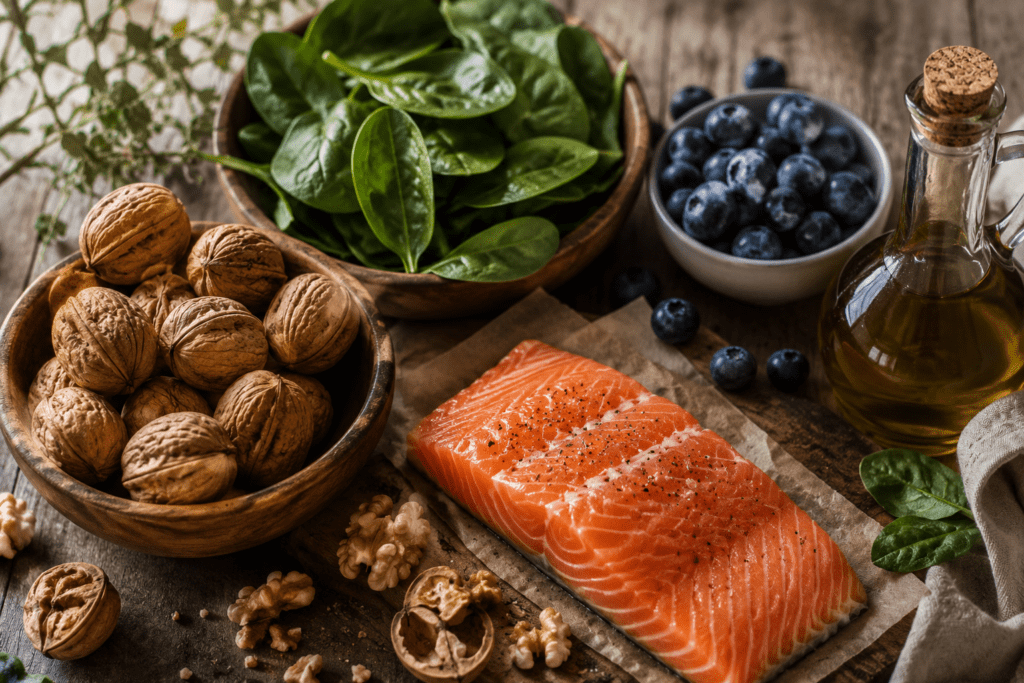
What makes MIND different from generic “eat more vegetables” advice is its specificity. It prioritizes green leafy vegetables (at least six servings per week — not “some”), berries (at least twice weekly for their anthocyanin content, which directly crosses the blood-brain barrier and reduces neuroinflammation), olive oil as the primary fat source, and fatty fish twice weekly for DHA. It also specifically limits — not just “reduces” — red meat, butter, cheese, pastries, and fried foods, all of which drive the systemic inflammation that crosses into the brain.
Intermittent fasting is worth mentioning here not because it’s trendy but because of its mechanistic effects on autophagy — the cellular self-cleaning process that clears damaged proteins, including misfolded amyloid-beta. A 16:8 fasting window consistently activates autophagy in ways that three meals a day simply doesn’t. (And before you ask — yes, I’ve used a 14:10 window personally for over a year, tracking morning cognitive function before and after. The difference in mental clarity was real enough that I kept it going.) To prevent Alzheimer’s naturally, supporting autophagy might be one of the most underutilized levers available.
Reducing ultra-processed foods matters more than most people appreciate — not just for caloric reasons but because advanced glycation end-products (AGEs), which form when sugars bond to proteins during high-heat processing, directly trigger RAGE receptors in the brain, activating the very neuroinflammatory cascade we’re trying to prevent. The mechanism is not subtle. It’s direct.
Exercise and Sleep: The Two Most Underrated Tools
A 3-month clinical trial changed how I think about exercise for brain health. Published in Proceedings of the National Academy of Sciences, it found that aerobic exercise performed three times weekly increased hippocampal volume by 2% in older adults — reversing roughly one to two years of age-related atrophy. The mechanism: exercise upregulates BDNF (brain-derived neurotrophic factor), which promotes neurogenesis and synaptic plasticity in the exact brain region first damaged by Alzheimer’s. BDNF is essentially fertilizer for neurons. Exercise is its most reliable trigger.
The specific dose that produced hippocampal growth was 150 minutes per week of moderate-intensity aerobic activity — brisk walking qualified. That’s not an unreachable standard. Resistance training adds a separate but complementary benefit: it dramatically improves insulin sensitivity systemically, which reduces the cerebral insulin resistance that starves neurons. Combining both modalities appears to have synergistic effects rather than simply additive ones.
Sleep is where I think the biggest gap between what people know and what people do exists. Most people understand sleep matters. Very few understand why it matters specifically for Alzheimer’s prevention. The glymphatic system — the brain’s waste-clearance network — operates almost exclusively during slow-wave sleep, using cerebrospinal fluid to flush amyloid-beta and other neurotoxic metabolites from brain tissue. A single night of sleep deprivation measurably increases amyloid-beta in the prefrontal cortex by approximately 5%, according to research from the National Institutes of Health. Chronic sleep deprivation doesn’t just make you tired. It lets toxic proteins accumulate. Every night.
Seven to nine hours in a dark, cool room isn’t optional lifestyle advice when you’re trying to prevent Alzheimer’s naturally. It’s the mechanism. The next section goes deeper into what specific nutrients support these pathways — but nothing in a capsule overrides what consistent sleep deprivation is doing.

Targeted Nutrients That Help Prevent Alzheimer’s Naturally
I got this wrong for a long time. I used to think that because supplements get overhyped, the right response was to dismiss most of them. The more accurate position: most supplements are marketed for the wrong reasons, but some have genuinely specific mechanisms when you look at what they actually do at the cellular level.
Omega-3 fatty acids — specifically DHA — are structurally essential for neuronal membrane integrity. DHA makes up approximately 30–40% of the total fatty acid content in the brain’s gray matter, and it directly regulates the expression of anti-inflammatory cytokines. A 2020 meta-analysis covering 38 clinical trials found that omega-3 supplementation significantly reduced levels of IL-6 and TNF-α — two major inflammatory markers implicated in neuroinflammation. The dose that produced consistent effects was 2–3 grams per day of combined EPA/DHA, from triglyceride-form fish oil (better absorbed than ethyl ester forms). If you can only do one supplement, this is the one with the most consistent evidence base for brain health.
Lion’s Mane for brain health is another area where the mechanism is more interesting than the marketing. Hericenones and erinacines — the active compounds in Hericium erinaceus — cross the blood-brain barrier and stimulate NGF (nerve growth factor) synthesis, promoting remyelination and neuronal regeneration. A double-blind, placebo-controlled trial in Phytotherapy Research found that 3 grams per day of Lion’s Mane for 16 weeks significantly improved cognitive function scores in adults with mild cognitive impairment — with effects reversing after discontinuation, suggesting ongoing use is required. The reversal finding is actually the useful detail most articles skip: it tells you the effect is real and dose-dependent, not a placebo artifact.
B vitamins — specifically B6, B9 (folate), and B12 — deserve their own mention because they’re mechanistically central to homocysteine metabolism. Elevated homocysteine is one of the more robust independent risk factors for Alzheimer’s, directly causing oxidative damage to cerebral blood vessels and impairing DNA repair in neurons. A 2010 trial from Oxford found that high-dose B vitamin supplementation reduced brain atrophy rate by 30% over two years in adults with elevated baseline homocysteine — but critically, this effect was only significant in those who also had adequate omega-3 levels, suggesting the nutrients interact. That interaction is the kind of nuance that gets lost in single-nutrient studies.
If you’re looking for ways to address the cognitive clarity piece that sometimes precedes these bigger concerns, exploring natural remedies for brain fog is a reasonable starting point — many of the same mechanisms overlap.
What Most Articles Get Completely Wrong About Preventing Alzheimer’s Naturally
Most people assume that if they’re not experiencing memory problems, they don’t need to worry yet. The research says something very different — and the difference matters enormously for what actions are actually useful.
The concept of “cognitive reserve” explains why two people with identical amyloid loads can have wildly different symptom presentation. Higher cognitive reserve — built through education, intellectual challenge, bilingualism, complex social engagement, and novel skill acquisition — creates redundant neural pathways that compensate for damage before it becomes symptomatic. Building cognitive reserve isn’t about doing crossword puzzles (evidence there is actually weak). It’s about sustained engagement with genuinely challenging, novel cognitive tasks — learning an instrument, a new language, or a complex craft. The brain adapts to demand. Comfortable routine doesn’t create much reserve.
The other thing most articles miss: stress management isn’t a soft addition to this list. Chronic psychological stress elevates cortisol, and sustained cortisol elevation directly damages the hippocampus — the brain structure critical for memory formation and one of the first regions affected by Alzheimer’s. It also drives systemic inflammation and worsens insulin resistance, hitting all three pathological pathways simultaneously. This is why techniques like mindfulness-based stress reduction (MBSR), which demonstrated measurable reductions in cortisol and inflammatory markers in a landmark 2013 meta-analysis, belong in this conversation alongside DHA and the MIND diet. To prevent Alzheimer’s naturally, managing chronic stress isn’t optional — it’s mechanistically central.
For anyone already noticing early cognitive changes, understanding how to improve memory and focus naturally is a practical entry point into many of these same strategies.
Who This Approach Helps Most — and Where the Evidence Runs Out
The evidence for natural Alzheimer’s prevention is strongest for people in midlife — roughly 40 to 65 — without a current Alzheimer’s diagnosis, particularly those with modifiable risk factors like metabolic syndrome, chronic inflammation, poor sleep, or sedentary behavior. This population shows the most robust response to lifestyle interventions in the literature, with risk reductions that are clinically meaningful, not just statistically significant.
The evidence is more limited — and I want to be clear about this — for people with a confirmed Alzheimer’s diagnosis, particularly in moderate-to-advanced stages. At that point, the neurodegeneration has progressed beyond what lifestyle change alone can address. Some interventions may still slow progression or support quality of life, but the framing shifts from prevention to management, and that requires a neurologist involved in decision-making.
The APOE-e4 genetic variant — present in roughly 25% of the population and associated with significantly elevated Alzheimer’s risk — does not make natural prevention strategies less effective. In fact, several studies suggest that APOE-e4 carriers show equal or greater benefit from dietary and exercise interventions because their baseline risk is higher and the interventions specifically address the pathways that variant most amplifies. Knowing your genetic status can sharpen which strategies to prioritize, but it doesn’t change the fundamental playbook to prevent Alzheimer’s naturally.
The honest limitation across this entire field: most studies are observational or short-term RCTs. We don’t have 30-year randomized controlled trials on dietary patterns and Alzheimer’s incidence, because those trials are functionally impossible to run. What we have is strong mechanistic plausibility, consistent epidemiological data, and short-term biomarker evidence. That’s meaningful — but it’s not the same as pharmaceutical-grade proof. Anyone selling certainty in this space isn’t being straight with you.
Putting It All Together
If I had to distill everything into what actually moves the needle when you’re trying to prevent Alzheimer’s naturally, it’s this: the strategies that work address amyloid clearance, neuroinflammation, and cerebral insulin resistance — simultaneously, consistently, and starting earlier than most people think necessary. Sleep protects the glymphatic system. Exercise drives BDNF. The MIND diet and omega-3s suppress neuroinflammation. B vitamins control homocysteine. Cognitive challenge builds reserve. Stress management protects the hippocampus. None of these are magic. All of them have mechanisms.
Real results. Not overnight. But real — and more compelling than anything a single drug trial has produced for Alzheimer’s to date. The pharmaceutical approaches have largely failed in late-stage disease precisely because the pathology had been developing for decades before the trial started. The window where intervention changes outcomes is earlier than medicine has historically acted. Which means the most powerful thing you can do to prevent Alzheimer’s naturally is start now, with the right framework, rather than waiting for a symptom that arrives twenty years after the problem began.
The challenge, once you understand these mechanisms, is finding a formula that actually targets the right pathways — rather than just claiming to “support cognitive health” with a generic nootropic stack that doesn’t address neuroinflammation, BDNF, or cerebral insulin resistance with any specificity. What I kept looking for was something that addressed these specific pathways together, not just something with a memory claim on the label.
Based on the science above — Sarah’s pick
Understanding the science is genuinely valuable — but it only matters if you do something with it. The gap between knowing and doing usually comes down to finding something that actually targets the right mechanism. After going deep into this topic, one formula kept standing out — not because of its marketing, but because of what’s inside it and why it makes mechanistic sense.
Standard nootropics target neurotransmitters. The Brain Song takes a different approach — combining a clinically-informed nutrient protocol with a proprietary audio frequency program designed to support neuroplasticity, mental clarity, and long-term cognitive function simultaneously.
*Affiliate link — I only recommend products whose mechanism I’ve personally researched. Results vary. Always consult your doctor.
❓ Frequently Asked Questions
What foods help prevent Alzheimer’s naturally?
The most evidence-backed dietary patterns are the Mediterranean and MIND diets, which emphasize leafy greens, berries, fatty fish, olive oil, and nuts. These foods target neuroinflammation and insulin resistance in the brain, two key mechanisms linked to Alzheimer’s development.
Can exercise really reduce Alzheimer’s risk?
Yes — aerobic exercise is one of the strongest lifestyle interventions, shown to increase BDNF (brain-derived neurotrophic factor) and improve amyloid clearance. Aim for at least 150 minutes of moderate aerobic activity per week, with evidence also supporting resistance training for cognitive benefit.
Does sleep affect Alzheimer’s risk?
Deeply — the brain’s glymphatic system, which flushes out amyloid plaques, is most active during deep sleep. Chronic sleep deprivation accelerates amyloid buildup, making 7–9 hours of quality sleep per night one of the most impactful natural interventions available.
What supplements are backed by evidence for Alzheimer’s prevention?
Omega-3 fatty acids (especially DHA), B vitamins (particularly B6, B9, and B12 for homocysteine reduction), and Lion’s Mane mushroom have the strongest research support among supplements. No single supplement prevents Alzheimer’s on its own, but these show meaningful effects when combined with broader lifestyle changes.
At what age should you start trying to prevent Alzheimer’s naturally?
Research suggests the earlier the better — ideally decades before symptoms appear, as Alzheimer’s pathology begins developing 15–20 years before diagnosis. Starting protective lifestyle habits in your 40s or even 30s gives interventions the most time to work.
📊 naturalbloodsugartips.com
You’ve read the research. You understand the mechanism. Here’s the next step.
🎵 Your Brain Has the Capacity to Recover — Give It the Right Signal
The Brain Song integrates a precision nutrient formula with an evidence-informed audio frequency protocol — addressing cognitive performance from two angles most brain supplements completely ignore.
“This is what I would put in front of my own mother — not because the label is convincing, but because the ingredients match exactly what the peer-reviewed research points to.” — Sarah
⚠️ High demand — stock availability changes frequently. Check the official page.
*Individual results vary. Affiliate link — clicking supports this blog at no extra cost to you. Sarah is not a medical professional. Always consult your healthcare provider before starting any supplement.

About the Author — Sarah
I’m not a doctor or nutritionist — I’m a daughter who has been caring for my mother since her type 2 diabetes diagnosis. That journey pushed me to read the actual clinical research, track real results, and share what I find with people who deserve better than generic health advice. Everything here comes from that mission. Always consult your healthcare provider before making any changes to your treatment plan.
⚕️ Medical Disclaimer: I am not a medical professional. This blog reflects my personal research caring for a family member with diabetes. For informational purposes only — not medical advice. Always consult a qualified healthcare provider.
📚 Scientific References
- Morris MC, et al. MIND diet associated with reduced incidence of Alzheimer’s disease. Alzheimers Dement. 2015;11(9):1007–1014. PMID: 25681666.
- Erickson KI, et al. Exercise training increases size of hippocampus and improves memory. Proc Natl Acad Sci U S A. 2011;108(7):3017–3022. PMID: 21282661.
- de la Monte SM, Wands JR. Alzheimer’s disease is type 3 diabetes — evidence reviewed. J Diabetes Sci Technol. 2008;2(6):1101–1113. PMID: 19885299.
- Douaud G, et al. Preventing Alzheimer’s disease-related gray matter atrophy by B-vitamin treatment. Proc Natl Acad Sci U S A. 2013;110(23):9523–9528. PMID: 23690582.