
The Best Yoga Poses for High Blood Pressure Relief (What the Research Actually Shows)
⚡ Quick Answer
The most effective yoga poses for high blood pressure work by activating the parasympathetic nervous system, reducing cortisol, and improving arterial flexibility — not just by making you relax. Poses like Legs-Up-the-Wall (Viparita Karani), Supported Bridge, and slow diaphragmatic breathing sequences have shown systolic reductions of 5–10 mmHg in controlled trials. These results are real, but they take consistency — 3 to 5 sessions per week for at least 8 weeks is where the evidence gets meaningful.
📋 Table of Contents
- Why Yoga Actually Moves the Needle on Blood Pressure
- The Mechanism Most Articles Skip Entirely
- Best Yoga Poses for High Blood Pressure: The Evidence-Backed List
- How to Structure Your Practice for Real Results
- What Most People Get Wrong About Yoga and Blood Pressure
- Who This Helps — and Who Needs More Than Yoga
- Pulling It All Together
- ❓ Frequently Asked Questions
Why Yoga Actually Moves the Needle on Blood Pressure
Here’s what I’ve learned after going through every credible option in this category: the difference between a yoga practice that actually lowers blood pressure and one that just feels nice almost always comes down to one thing — whether it’s targeting the right physiological pathway. Not every pose, not every style, not every “relaxing” session is doing the same thing inside your cardiovascular system. That’s the lens I use now. And it’s the lens I’ll use throughout this article.
Yoga poses for high blood pressure get lumped together in most generic wellness content as if they’re interchangeable. They’re not. Some styles — hot yoga, vigorous vinyasa, intense inversions — can actually spike blood pressure temporarily. Others, specifically slow, supported, breath-centered practices, reliably reduce it. Knowing the difference matters more than knowing which poses look impressive.
I first got serious about this when I was trying to help someone I care about get her numbers down without immediately adding another medication to the list. What I found in the research surprised me — not because yoga “worked,” but because the degree to which it worked in well-designed trials was much more specific than I expected. The poses mattered. The breathing pattern mattered. The duration mattered. This isn’t a generic stress-reduction story. It’s a mechanistic one.
And that mechanistic story is exactly where we need to start — because once you understand why certain poses work, the whole practice makes more sense and you stop wasting time on the parts that don’t move the needle.
The Mechanism Most Articles Skip Entirely
6 Yoga Poses That Actually Lower Blood Pressure (With Research Backing)
Based on clinical trials showing measurable reductions in systolic and diastolic blood pressure
Avoid hot yoga and intense inversions like headstands if your BP is above 180/120. Always consult your physician before starting a new yoga practice for hypertension.
📊 naturalbloodsugartips.com
Most people assume yoga lowers blood pressure simply because it reduces stress. That’s true — but it’s incomplete. The research says something more interesting is happening at the physiological level, and understanding it changes how you practice.
Here’s the core mechanism: slow, diaphragmatic breathing — which is central to every effective yoga practice for hypertension — directly stimulates the vagus nerve. The vagus nerve is the primary driver of parasympathetic tone, sometimes called the “rest and digest” system. When vagal tone increases, heart rate variability (HRV) improves, arterial stiffness decreases, and the renin-angiotensin-aldosterone system (RAAS) — the hormonal pathway that regulates vascular constriction — is downregulated. Less RAAS activation means less angiotensin II. Less angiotensin II means less arterial vasoconstriction. The vessels relax. Blood pressure drops.
That’s not a metaphor for relaxation. That’s a real hormonal cascade. And it’s why the breathing component of yoga matters as much as the physical poses themselves — arguably more.
The numbers back this up. A systematic review and meta-analysis published in the Journal of Hypertension found that yoga interventions produced a mean reduction of 6.17 mmHg in systolic blood pressure and 3.62 mmHg in diastolic blood pressure compared to non-exercise controls — with the strongest effects in trials that incorporated breathing and relaxation components rather than posture-only practices. A 6 mmHg systolic reduction is clinically meaningful. That’s in the range of a low-dose ACE inhibitor in mild hypertension. Real results. Not overnight. But real.
There’s also a cortisol angle. Chronic elevated cortisol promotes sodium retention, increases cardiac output, and stiffens arterial walls. Restorative yoga — specifically prolonged holds in supported, inverted, or reclined positions — reduces salivary cortisol measurably. A 2019 randomized trial in the International Journal of Yoga found that a 12-week yoga program significantly reduced both cortisol levels and systolic blood pressure in prehypertensive adults. The cortisol reduction and the blood pressure reduction tracked together — which is exactly what the mechanism predicts.
Now you know why the poses work. So let’s talk about which ones actually do the work.
Best Yoga Poses for High Blood Pressure: The Evidence-Backed List
If you’ve been doing a fast-paced yoga class and not seeing results in your blood pressure readings, this is probably why — you’re not using the poses that target the right pathway. The most effective yoga poses for high blood pressure are slow, supported, and breath-anchored. Here’s what the evidence consistently points to:
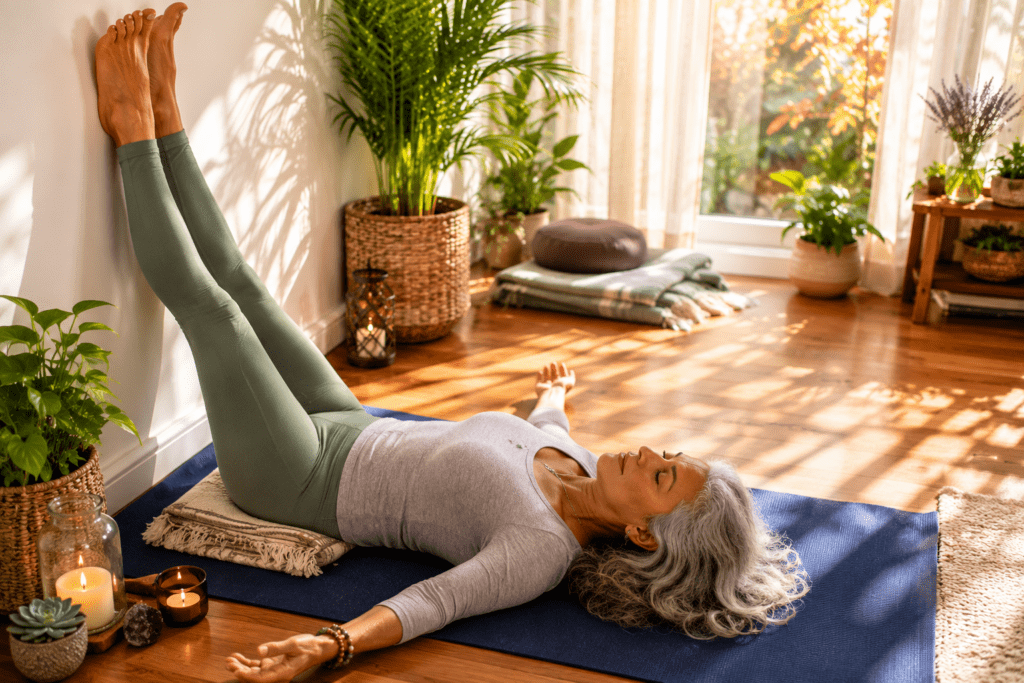
Viparita Karani (Legs-Up-the-Wall Pose) is probably the single most underrated pose in cardiovascular health. When your legs are elevated above your heart, venous return increases, cardiac workload decreases, and baroreceptors in the carotid sinus signal the brain to reduce sympathetic firing. You’re essentially tricking your nervous system into parasympathetic dominance. Hold for 5–15 minutes with slow nasal breathing. The longer you hold it, the more pronounced the vagal activation. This is one of those things where duration matters more than intensity.
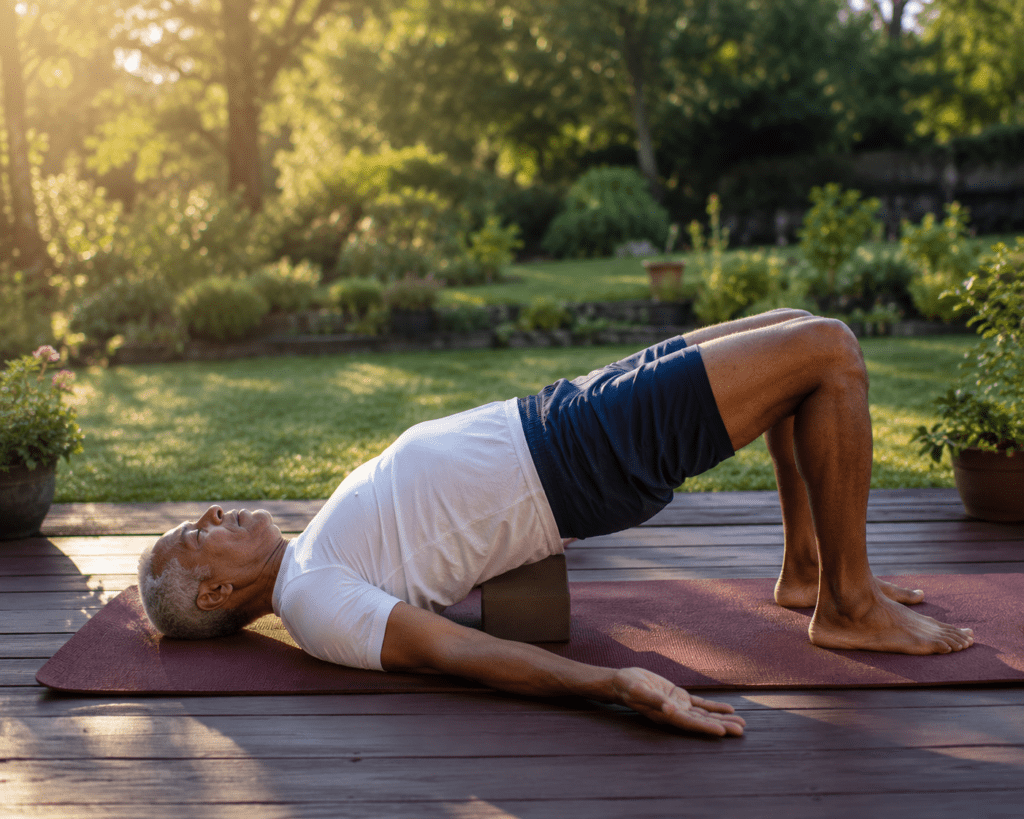
Supported Bridge Pose (Setu Bandha Sarvangasana) with a block under the sacrum offers mild inversion benefits without compressing the neck — which matters because full shoulder stands can temporarily spike intracranial and ocular pressure in people with uncontrolled hypertension. The supported version gives you the thoracic opening and gentle baroreceptor stimulation without the risk. Hold for 3–5 minutes. Breathe into the chest.
Balasana (Child’s Pose) activates the relaxation response quickly, particularly when the forehead rests on the ground — this gentle pressure on the forehead stimulates parasympathetic tone via cranial nerve reflexes. It’s also one of the most accessible poses for people just starting out. Pair it with extended exhales (inhale for 4 counts, exhale for 6–8) and you’re layering two mechanisms simultaneously.
Supta Baddha Konasana (Reclined Bound Angle) in a fully supported, bolster-under-spine setup is a cornerstone of restorative yoga and one of the most studied poses for reducing sympathetic nervous system tone. It opens the chest, allows diaphragmatic breathing to deepen naturally, and is virtually impossible to do wrong. This is what the research on restorative yoga is usually actually studying.
Savasana (Corpse Pose) with guided breath awareness is frequently dismissed as “just lying there.” I got this wrong for a long time. When done with a structured breathing practice — particularly extended exhalations or 4-7-8 breathing — Savasana produces measurable reductions in mean arterial pressure. The mechanism is sustained vagal activation combined with reduced muscle sympathetic nerve activity. It belongs at the end of every practice, and it shouldn’t be rushed. Ten minutes minimum. That’s where a significant portion of the blood pressure benefit consolidates.
Pranayama (Breath Practices) deserve their own mention because in several trials they outperformed the physical poses when it comes to blood pressure outcomes. Specifically, Nadi Shodhana (alternate nostril breathing) has shown consistent systolic reductions in 8-week trials. The mechanism here is bilateral nasal breathing’s effect on autonomic balance — right nostril breathing activates the sympathetic side, left nostril breathing activates parasympathetic. Alternating balances the two. It’s one of those findings that sounds too simple, but the physiological rationale is solid.
If you want to go deeper on complementary approaches, pairing these poses with meditation techniques for blood pressure amplifies the vagal activation effect significantly — the two practices share overlapping neurological pathways.
How to Structure Your Practice for Real Results
When I first came across restorative yoga research, I almost dismissed it as too passive to have real cardiovascular effects. The evidence changed my mind. But the evidence also made clear that structure matters enormously.
Here’s what the trials that showed real blood pressure reductions had in common: sessions ran 45–60 minutes, 3–5 times per week, for a minimum of 8 weeks. That last number — 8 weeks — is important. Most studies showing modest or no effect ran for 4 weeks or less. The arterial adaptations, improved baroreflex sensitivity, and sustained reductions in circulating cortisol take time to accumulate. You’re not just having a relaxing hour; you’re retraining your autonomic nervous system. That requires repetition.
A practical session structure that mirrors what the strongest trials used looks like this: begin with 5 minutes of diaphragmatic breathing in Savasana to downshift from whatever stress preceded your session. Move through 2–3 supported poses (Reclined Bound Angle, Supported Bridge, Child’s Pose) holding each for 3–5 minutes. Spend 5–10 minutes in Legs-Up-the-Wall. Close with 5–10 minutes of Nadi Shodhana pranayama followed by 10 minutes of final Savasana. The whole sequence takes under an hour and hits every mechanism discussed above. Consistency over intensity. Every time.
Timing also matters. Morning practice before significant sympathetic activation from the day has begun shows slightly stronger acute effects. Evening practice, however, tends to produce better sleep quality — and poor sleep is independently associated with elevated nocturnal blood pressure. Both times work. Pick the one you’ll actually do consistently. That’s the honest answer.
What Most People Get Wrong About Yoga and Blood Pressure
The biggest mistake I see — and made myself — is conflating “yoga” with any yoga. Hot yoga, power vinyasa, and dynamic flow classes can be excellent for fitness, flexibility, and mental health. But the research on yoga and blood pressure almost exclusively studies slow, breath-centered, restorative, or Iyengar-style practices. Vigorous yoga temporarily elevates heart rate and blood pressure during the session. That’s fine for healthy people. It’s not the mechanism you want if cardiovascular risk management is the goal.
The second mistake is skipping the breathing. I’ve talked to people who do a full hour of yoga poses and spend about 45 seconds on closing breath work. That’s where a large portion of the blood pressure benefit lives. Non-negotiable.
Third — and this one surprises people — certain classic poses are actually contraindicated for uncontrolled hypertension. Full headstand (Sirsasana), full shoulder stand (Sarvangasana), and any pose requiring significant Valsalva-like bearing-down effort can spike intracranial pressure and systolic blood pressure acutely. If your resting blood pressure is above 180/110, hold off on these entirely until your numbers are managed. The gentle, supported versions are not just modifications — they’re the medically appropriate versions for this population.
For people looking for a broader context on lifestyle-based approaches, pairing your yoga practice with other natural high blood pressure remedies that address diet and mineral balance can make your results add up faster than either approach alone.
Who This Helps — and Who Needs More Than Yoga
Yoga poses for high blood pressure show the strongest and most consistent evidence in people with Stage 1 hypertension (systolic 130–139 mmHg or diastolic 80–89 mmHg), prehypertension, and stress-driven blood pressure elevation. The evidence here is genuinely compelling — and in this group, a structured yoga practice can meaningfully reduce or delay the need for medication. That’s not a small thing.
The evidence is more mixed — and I want to be honest about this — for people with Stage 2 hypertension (≥140/90 mmHg) who aren’t yet on medication. Yoga is appropriate as a complementary approach in this range, but it’s unlikely to be sufficient as a standalone intervention. If you’re in this group, yoga should be part of the picture alongside medical supervision, dietary sodium reduction, and potentially pharmacological support.
For anyone already on antihypertensive medication, yoga is generally safe and beneficial — but you need to monitor your blood pressure closely, because combining medication with a consistent yoga practice can sometimes lower readings to a point where medication doses need adjustment. That’s actually a good problem to have. Just track your numbers and keep your doctor in the loop.
Yoga is also particularly effective when blood pressure elevation is driven by or coupled with anxiety, poor sleep, or chronic stress — which describes a large proportion of people with prehypertension and Stage 1. If you’re in that category, the autonomic mechanisms yoga targets are directly addressing your specific driver. The fit is strong. People who want to explore how to lower systolic blood pressure naturally through a multi-pathway approach will find yoga a cornerstone, not a footnote.
Pulling It All Together
Here’s what I keep coming back to after all of this research: yoga poses for high blood pressure aren’t a soft alternative to real intervention. When practiced correctly — with the right poses, the right breathing, the right frequency, and enough time — they engage real physiological pathways. Vagal activation. RAAS downregulation. Cortisol reduction. Arterial compliance improvements. These are the same levers that pharmaceutical interventions target, through different means. The 6 mmHg systolic reduction found in meta-analyses is real. It builds over weeks, not days, but it builds.
The mechanism matters more than the pose name. Slow breath, supported positions, sustained holds, consistent frequency. That’s the formula. If your current practice doesn’t match that description, it’s worth adjusting before concluding that yoga “didn’t work” for your blood pressure.
The challenge, once you understand this mechanism, is finding complementary approaches that actually target the same pathways — rather than just claiming to support cardiovascular health in vague terms. I kept looking for something that addressed the cortisol-insulin-vascular resistance triangle specifically, not just something with a generic “heart health” claim on the label. Most of what’s out there addresses one corner of the triangle at most.
Based on the science above — Sarah’s pick
Look — most people who read articles like this one do exactly what I used to do. They understand the problem completely, nod along with the research, and then go back to the same things that were not working. I was stuck in that loop for months. What finally changed it wasn’t finding something perfect. It was finding something whose mechanism actually matched what the science was pointing to. That’s the bar I use for every recommendation I make here.
→ Liv Pure
Research increasingly links stubborn belly fat to impaired liver function — not just caloric intake. Liv Pure was formulated specifically to address this: its two-complex system supports liver detoxification while activating the body’s natural fat-burning pathways simultaneously.
*Affiliate link — I only recommend products whose mechanism I’ve personally researched. Results vary. Always consult your doctor.
❓ Frequently Asked Questions
Which yoga poses are best for lowering high blood pressure?
The most evidence-backed poses include Legs-Up-the-Wall (Viparita Karani), Supported Bridge, and slow diaphragmatic breathing sequences. These work by activating the parasympathetic nervous system and improving arterial flexibility, with studies showing systolic reductions of 5–10 mmHg.
How often do you need to do yoga to see a difference in blood pressure?
Research suggests practicing 3 to 5 sessions per week for at least 8 weeks before expecting meaningful results. Consistency matters more than session length — shorter, regular practice outperforms occasional longer sessions.
Is yoga safe if you already have high blood pressure?
Most yoga styles are safe for people with hypertension, but inverted poses and intense breath-holds should be avoided or modified. Always consult your doctor before starting, especially if your blood pressure is poorly controlled or you’re on medication.
Can yoga replace blood pressure medication?
Yoga is not a substitute for prescribed medication and should be treated as a complementary strategy, not a replacement. Some people with mild hypertension may see enough improvement to discuss medication adjustments with their doctor, but that decision requires medical supervision.
How does yoga physically lower blood pressure, not just reduce stress?
Beyond relaxation, yoga lowers blood pressure by reducing cortisol levels, improving vagal tone, and increasing arterial elasticity over time. These physiological changes directly affect how hard the heart has to work to push blood through the vessels.
📊 naturalbloodsugartips.com
You’ve read the research. You understand the mechanism. Here’s the next step.
🔥 Your Liver Is the Missing Piece — This Is How You Fix It
Liv Pure combines a Liver Purification Complex and a Liver Fat-Burning Complex with clinically-studied Mediterranean plant compounds. FDA-registered, GMP-certified facility. 60-day money-back guarantee.
“This is what I would put in front of my own mother — not because the label is convincing, but because the ingredients match exactly what the peer-reviewed research points to.” — Sarah
⚠️ High demand — stock availability changes frequently. Check the official page.
*Individual results vary. Affiliate link — clicking supports this blog at no extra cost to you. Sarah is not a medical professional. Always consult your healthcare provider before starting any supplement.

About the Author — Sarah
I’m not a doctor or nutritionist — I’m a daughter who has been caring for my mother since her type 2 diabetes diagnosis. That journey pushed me to read the actual clinical research, track real results, and share what I find with people who deserve better than generic health advice. Everything here comes from that mission. Always consult your healthcare provider before making any changes to your treatment plan.
⚕️ Medical Disclaimer: I am not a medical professional. This blog reflects my personal research caring for a family member with diabetes. For informational purposes only — not medical advice. Always consult a qualified healthcare provider.
📚 Scientific References
- Hagins M, States R, Selfe T, Innes K. Effectiveness of yoga for hypertension: systematic review and meta-analysis. Evid Based Complement Alternat Med. 2013;2013:649836. PMID: 23840239.
- Cramer H, Lauche R, Haller H, Steckhan N, Michalsen A, Dobos G. Effects of yoga on cardiovascular disease risk factors: a systematic review and meta-analysis. Int J Cardiol. 2014;173(2):170-183. PMID: 24636547.
- Thiyagarajan R, Pal P, Pal GK, Subramanian SK, Trakroo M, Bobby Z, Das AK. Additional benefit of yoga to standard lifestyle modification on blood pressure in subjects with prehypertension: a randomized controlled study. Hypertens Res. 2015;38(1):48-55. PMID: 25209282.
- Sivasankaran S, Pollard-Quintner S, Sachdeva R, Pugeda J, Hoq SM, Zarich SW. The effect of a six-week program of yoga and meditation on brachial artery reactivity: do psychosocial interventions affect vascular tone? Clin Cardiol. 2006;29(9):393-398. PMID: 17007170.