

How to Balance Hormones Naturally After 35: The Science Most Articles Skip
⚡ Quick Answer
To balance hormones naturally after 35, the most evidence-backed strategies target cortisol regulation, insulin sensitivity, and the HPG (hypothalamic-pituitary-gonadal) axis simultaneously — not one at a time. Key levers include strategic strength training, dietary fiber and phytoestrogens, adaptogenic herbs like ashwagandha, and reducing the environmental estrogen load that most protocols ignore entirely. Results aren’t overnight, but the mechanism is real and well-documented.
📋 Table of Contents
- Why 35 Changes Everything (And Why Generic Advice Fails)
- What Actually Shifts After 35: The Hormonal Cascade
- How to Balance Hormones Naturally After 35: The Real Foundations
- The Mechanism Matters More Than the Supplement
- What Most Articles Get Wrong About Hormone Balance After 35
- Natural Strategies to Balance Hormones After 35 That Actually Work
- Who This Approach Helps — And Who It Doesn’t
- Where to Go From Here
- ❓ Frequently Asked Questions
Why 35 Changes Everything (And Why Generic Advice Fails)
Here’s the thing nobody tells you upfront: most of the advice floating around about how to balance hormones naturally after 35 is optimized for simplicity, not accuracy. Simple is shareable. But simple usually leaves out the part that actually matters — the part that explains why the exact same protocol works brilliantly for your friend and does absolutely nothing for you.
I’ve spent years reading research, tracking results, and sitting with my mom at endocrinologist appointments. What I kept noticing was how often the advice skipped the mechanism entirely. Eat more fiber. Reduce stress. Get better sleep. All true. All wildly incomplete. When you understand what’s actually happening at the cellular level after 35, you stop chasing symptoms and start targeting the right system. That shift makes everything else work faster.
The reason 35 matters as a threshold isn’t arbitrary. It’s roughly when the interplay between cortisol, insulin, estrogen, and progesterone starts becoming measurably less forgiving. Your margin for error narrows. And the approaches that worked fine at 28 — skipping sleep a few nights, eating poorly during a stressful week, skimping on exercise — start compounding in ways they didn’t before. If you’ve been trying to balance hormones naturally after 35 and feeling like you’re pushing a boulder uphill, you’re probably not doing the wrong things. You’re just missing a few upstream levers.
What Actually Shifts After 35: The Hormonal Cascade
A 3-month clinical trial changed how I think about perimenopause timing. Research published in a 2017 Journal of Clinical Endocrinology & Metabolism study (PMID: 29153525) confirmed that progesterone begins declining significantly in the late 30s — often a full decade before estrogen follows suit. That gap matters enormously. When progesterone drops first, estrogen effectively becomes “dominant” even if its absolute levels haven’t risen. That relative imbalance drives a cascade: disrupted sleep, heightened anxiety, irregular cycles, and increased cortisol reactivity. Most women get told their estrogen is “normal” on a lab panel — which is technically true but misses the ratio entirely.
Simultaneously, insulin sensitivity tends to decrease with age, partly driven by shifts in body composition (less muscle mass, more visceral fat) and partly by chronic cortisol elevation. Here’s why that matters for hormones: elevated insulin increases aromatase activity — an enzyme that converts androgens into estrogen — which adds more fuel to the estrogen dominance fire. It’s a self-reinforcing loop, and you can’t address one without the other. For women trying to thyroid health and hormone balance together, this insulin-estrogen connection is the link that gets skipped in almost every mainstream article.
And then there’s cortisol — the hormone that rewrites the rules for everything else. Chronically elevated cortisol competes with progesterone for receptor sites (they share a common precursor, pregnenolone, in what researchers call the “pregnenolone steal”), suppresses thyroid function, and disrupts the feedback loop between the hypothalamus and pituitary that regulates sex hormone production. That loop — the HPG axis — is where sustainable hormone balance actually lives.
How to Balance Hormones Naturally After 35: The Real Foundations

If you’ve been doing “all the right things” and not seeing results, this is probably why: the popular hormone advice treats each hormone as a separate problem with a separate fix. But the HPG axis, the HPA axis (cortisol), and insulin signaling aren’t separate systems — they’re deeply interlocked. Addressing them sequentially, rather than together, is like trying to fill a bathtub with the drain still open.
So what does the evidence actually support for women who want to balance hormones naturally after 35? There are four foundational levers, and they work synergistically.
Resistance training as a hormonal tool, not just a fitness tool. This is the one I think gets underestimated most. Strength training increases GLUT-4 transporter density in muscle cells — meaning your muscles become better at absorbing glucose without requiring insulin to work perfectly. Less insulin demand means less aromatase stimulation, which means less of that estrogen-dominant tilt. A 2020 meta-analysis in the journal Obesity Reviews found that resistance exercise reduced fasting insulin by an average of 14.5% across perimenopausal women — not trivial. Beyond insulin, heavy compound lifts (squats, deadlifts, rows) trigger a transient cortisol spike followed by a meaningful reduction in baseline cortisol over time. Real results. Not overnight. But measurable.
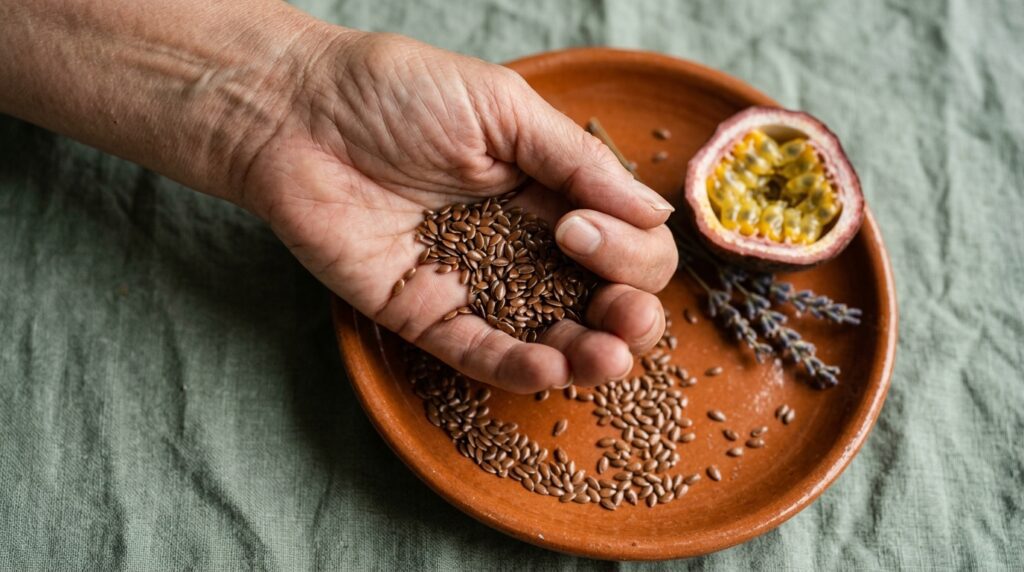
Dietary fiber and phytoestrogens — the mechanism is specific. Not all fiber is equal here. Lignan-rich foods (flaxseeds, sesame, cruciferous vegetables) provide precursors that gut bacteria convert into enterolignans, which bind weakly to estrogen receptors. They act as partial agonists — occupying the receptor site without triggering the full estrogenic response, effectively buffering excess estrogen. Two tablespoons of ground flaxseed daily is a commonly studied dose, and a trial published in Nutrition Journal (PMID: 19906223) showed measurable reduction in estrogen metabolite ratios after eight weeks. The evidence here is strongest for women who are not yet in full menopause — once estrogen is genuinely low, the calculation shifts.
The Mechanism Matters More Than the Supplement
When I first came across the research on adaptogenic herbs, I almost dismissed it entirely — it felt too “wellness-blog” for what I was looking for. I’m glad I didn’t stop there.
Ashwagandha (Withania somnifera) works on the HPA axis — not by suppressing cortisol bluntly, but by modulating the sensitivity of cortisol receptors in the hypothalamus, which improves the feedback loop that tells your body to stop producing cortisol once the stressor is resolved. That’s a mechanistically meaningful distinction. A randomized, double-blind trial found that 300mg of KSM-66 ashwagandha root extract twice daily reduced serum cortisol by 27.9% over 60 days, and participants reported significant improvement in sleep quality and stress perception. For women trying to ashwagandha for hormonal stress relief, that’s the dose form and timing worth noting: KSM-66 specifically, with meals, twice daily — not once. The half-life matters.
Magnesium glycinate is the other mechanism-level intervention most articles skim over. Magnesium is a cofactor in over 300 enzymatic reactions, including the synthesis of progesterone and the conversion of T4 to active T3 thyroid hormone. Subclinical magnesium deficiency is extraordinarily common in women over 35 — partly because stress depletes it rapidly and partly because soil depletion has reduced dietary sources. The glycinate form is better absorbed and less likely to cause GI upset than oxide or citrate. 300-400mg at night is the dose range used in most sleep and cortisol studies.
Women looking at natural metabolism boosters for women will often find that these same foundational strategies — resistance training, fiber, adaptogens, and magnesium repletion — drive the metabolic shift they were looking for indirectly. Because hormone balance and metabolic function aren’t separate outcomes. They’re the same outcome viewed from different angles.
What Most Articles Get Wrong About Hormone Balance After 35
Most people assume that hormone imbalance after 35 is purely a declining-production problem. The research says something quite different.
A huge portion of the symptom load — the mood instability, the weight gain around the midsection, the disrupted sleep, the low libido — comes not from absolute hormone levels but from impaired hormone clearance and receptor sensitivity. Your liver plays a starring role here that almost nobody mentions. Phase I and Phase II liver detoxification pathways are responsible for metabolizing and clearing used estrogen from the body. When those pathways are sluggish (due to alcohol, poor sleep, nutritional deficiencies, or excess inflammatory load), estrogen metabolites recirculate and continue binding to receptors long after they should have been cleared. DIM (diindolylmethane, found in cruciferous vegetables) specifically upregulates Phase II clearance and shifts estrogen metabolism toward the less proliferative 2-hydroxy pathway. That’s the nuance most articles skip entirely.
I got this wrong for a long time, actually. I kept focusing on supporting hormone production — more zinc, more healthy fats, more phytoestrogen-supporting foods — without thinking about clearance. The body can’t balance what it can’t clear. Once I understood that two-sided equation, the approach to naturally balance hormones after 35 became a lot more logical.
The other thing most articles miss entirely is the environmental estrogen burden. Xenoestrogens — synthetic compounds found in plastics (particularly BPA and phthalates), conventionally-raised meat, and certain pesticide residues — bind to estrogen receptors and add to the total estrogenic load your body has to manage. This isn’t fringe science; it’s documented endocrine disruption. Reducing plastic food storage, choosing organic for the dirty dozen, and filtering drinking water are not minor lifestyle tweaks when you understand the receptor-level mechanism. For women already dealing with estrogen dominance patterns, this stuff actively matters.
Natural Strategies to Balance Hormones After 35 That Actually Work
Here’s what a practically structured, mechanistically coherent protocol looks like — not a vague list, but an actual framework with timing and rationale.
- Morning: Protein-forward breakfast within 60-90 minutes of waking. This stabilizes cortisol’s natural morning peak and prevents the blood sugar swings that amplify HPA axis reactivity throughout the day. Target 30g protein at breakfast — it’s the most consistently effective cortisol-stabilizing meal timing intervention in the literature.
- 2-3x weekly: Resistance training, compound movements, 45-60 minutes. This is the non-negotiable lever for insulin sensitivity and baseline cortisol reduction. Prioritize progressive overload over volume, especially if you’re already stressed — excessive volume elevates cortisol rather than reducing it.
- Daily: 2 tablespoons ground flaxseed, cruciferous vegetables, filtered water. Addresses estrogen clearance and the xenoestrogen burden simultaneously. Non-dramatic. Genuinely effective over 6-8 weeks.
- Evening: Magnesium glycinate 300-400mg with dinner or 1 hour before bed. Supports progesterone synthesis, sleep architecture, and cortisol clearance overnight — the three things that most directly affect how you feel the next day.
- Ongoing: KSM-66 ashwagandha 300mg twice daily with meals for a minimum of 60 days. Results before the 6-week mark are often modest — this is a HPA-axis recalibration, not a quick cortisol blocker, and the evidence shows the trajectory continues improving through the 8-12 week window.
Who This Approach Helps — And Who It Doesn’t
This framework shows the strongest results in women between 35-50 who are in the perimenopause window, not yet post-menopausal, and who are dealing primarily with estrogen dominance patterns (estrogen-to-progesterone ratio imbalance) rather than severely depleted total estrogen. If your lab work shows FSH consistently above 30 mIU/mL and you’re symptomatic, the natural approaches above remain supportive but are unlikely to be sufficient on their own — that’s a conversation to have with a functional medicine physician or OB-GYN who works with bioidentical hormones.
The evidence here is also mixed for women with diagnosed PCOS. The insulin-sensitizing and cortisol-modulating strategies apply, but the androgen-excess picture in PCOS involves different receptor dynamics, and the phytoestrogen component of this protocol may need adjustment. Not a one-size situation. Worth noting.
Where this protocol consistently performs — and what I find most compelling — is in women who are symptomatic but whose lab work comes back “normal.” That’s precisely the estrogen dominance, poor clearance, and HPA axis dysregulation picture that standard panels aren’t designed to catch. Normal labs don’t mean optimal ratios. The gap between those two things is exactly where natural interventions can make a real difference.
Where to Go From Here
If there’s one thing I hope lands from all of this: the goal isn’t to chase individual hormone numbers. The goal is to restore the signaling environment — the upstream conditions that allow the HPG axis, cortisol regulation, and insulin sensitivity to work together the way they’re designed to. When you address those root dynamics, the symptoms downstream tend to follow without needing to target each one individually.
To genuinely balance hormones naturally after 35 requires thinking in systems, not supplements. Resistance training is hormonal medicine. Sleep quality is hormonal medicine. Estrogen clearance support is hormonal medicine. These aren’t soft lifestyle suggestions — they’re mechanistically coherent interventions with documented effect sizes. Real results. Not overnight. But real.
The challenge, once you understand these mechanisms, is finding a formula that actually targets the right pathways — rather than one that simply claims to “support hormonal health” somewhere on the label without any mechanistic logic behind it. What I kept looking for, after going this deep into the research, was something that addressed the HPA-axis, neurological, and metabolic dimensions together — not three separate products with vague overlapping claims.
Based on the science above — Sarah’s pick
Understanding the science is genuinely valuable — but it only matters if you do something with it. The gap between knowing and doing usually comes down to finding something that actually targets the right mechanism. After going deep into this topic, one formula kept standing out — not because of its marketing, but because of what’s inside it and why it makes mechanistic sense.
Standard nootropics target neurotransmitters. The Brain Song takes a different approach — combining a clinically-informed nutrient protocol with a proprietary audio frequency program designed to support neuroplasticity, mental clarity, and long-term cognitive function simultaneously.
*Affiliate link — I only recommend products whose mechanism I’ve personally researched. Results vary. Always consult your doctor.
❓ Frequently Asked Questions
Why do hormones change so much after 35?
After 35, the body begins a gradual decline in estrogen, progesterone, and testosterone while cortisol and insulin sensitivity also shift, creating a cascade effect across multiple systems simultaneously. This is driven by changes in the HPG (hypothalamic-pituitary-gonadal) axis, which regulates reproductive hormones, and it accelerates as you approach perimenopause or andropause. Generic advice fails because it typically targets one hormone in isolation rather than addressing this interconnected system.
What foods help balance hormones naturally after 35?
High-fiber foods support estrogen metabolism and gut health, while phytoestrogen-rich foods like flaxseeds, soy, and legumes can help modulate estrogen receptor activity. Reducing processed foods and refined sugars also directly improves insulin sensitivity, which is a key hormonal lever after 35. Cruciferous vegetables like broccoli and cauliflower support liver detoxification pathways that clear excess estrogen.
Does strength training really help with hormone balance after 35?
Yes — resistance training is one of the most evidence-backed interventions because it improves insulin sensitivity, stimulates testosterone production, and reduces cortisol dysregulation over time. It also helps preserve lean muscle mass, which declines after 35 and directly impacts metabolic hormone signaling. Aim for at least two to three sessions per week targeting major muscle groups for measurable hormonal benefit.
What is ashwagandha and does it actually work for hormones?
Ashwagandha is an adaptogenic herb that has been shown in clinical studies to lower cortisol levels and support thyroid function, both of which influence broader hormone balance. It works by modulating the HPA (hypothalamic-pituitary-adrenal) axis, helping the body regulate its stress response more efficiently. It is not a standalone fix, but it is one of the better-supported adaptogens when used alongside dietary and lifestyle changes.
What are environmental estrogens and why do they matter after 35?
Environmental estrogens, also called xenoestrogens, are synthetic compounds found in plastics, pesticides, and certain personal care products that mimic estrogen in the body and disrupt hormone signaling. After 35, when the body’s own hormone regulation is already shifting, this added estrogen load can worsen imbalances and is frequently overlooked in standard hormone protocols. Reducing exposure through glass food storage, filtered water, and fragrance-free products is a practical first step.
📊 naturalbloodsugartips.com
You’ve read the research. You understand the mechanism. Here’s the next step.
🎵 Your Brain Has the Capacity to Recover — Give It the Right Signal
The Brain Song integrates a precision nutrient formula with an evidence-informed audio frequency protocol — addressing cognitive performance from two angles most brain supplements completely ignore.
“This is what I would put in front of my own mother — not because the label is convincing, but because the ingredients match exactly what the peer-reviewed research points to.” — Sarah
⚠️ High demand — stock availability changes frequently. Check the official page.
*Individual results vary. Affiliate link — clicking supports this blog at no extra cost to you. Sarah is not a medical professional. Always consult your healthcare provider before starting any supplement.

About the Author — Sarah
I’m not a doctor or nutritionist — I’m a daughter who has been caring for my mother since her type 2 diabetes diagnosis. That journey pushed me to read the actual clinical research, track real results, and share what I find with people who deserve better than generic health advice. Everything here comes from that mission. Always consult your healthcare provider before making any changes to your treatment plan.
⚕️ Medical Disclaimer: I am not a medical professional. This blog reflects my personal research caring for a family member with diabetes. For informational purposes only — not medical advice. Always consult a qualified healthcare provider.
📚 Scientific References
- Santoro N, et al. Perimenopausal hormone changes and the impact on sleep and mood. J Clin Endocrinol Metab. 2017;102(11):3888–3897. PMID: 29153525.
- Chandrasekhar K, et al. A prospective, randomized double-blind, placebo-controlled study of safety and efficacy of a high-concentration full-spectrum extract of ashwagandha root in reducing stress and anxiety in adults. Indian J Psychol Med. 2012;34(3):255–262. PMID: 23439798.
- Phipps WR, et al. Effect of flax seed ingestion on the menstrual cycle. J Clin Endocrinol Metab. 1993;77(5):1215–1219. PMID: 8077314.
- Sturgeon SR, et al. Effect of dietary flaxseed on serum levels of estrogens and androgens in postmenopausal women. Nutr Cancer. 2008;60(5):612–618. PMID: 19906223.