

Chromium Picolinate Blood Sugar Benefits: What the Research Actually Shows
⚡ Quick Answer
Chromium picolinate blood sugar benefits are driven by the mineral’s role in potentiating insulin signaling — specifically by activating a chromium-binding protein called chromodulin that amplifies insulin receptor activity at the cellular level. Clinical trials show it can reduce fasting glucose by 15–25 mg/dL and lower HbA1c by roughly 0.5–1.0% in people with insulin resistance or type 2 diabetes over 8–16 weeks. It works best for people in the prediabetic or early type 2 range whose insulin resistance is the primary driver — not as a standalone fix for advanced disease.
📋 Table of Contents
- Why Most Supplement Labels Are Useless (And What to Filter For)
- Chromium Picolinate Blood Sugar Benefits: The Direct Answer
- The Cellular Mechanism Behind Chromium Picolinate Blood Sugar Benefits
- Dosage, Timing, and Form: What the Studies Actually Used
- What Most Articles Get Wrong About Chromium Supplementation
- Who Gets the Most from Chromium — and Who Probably Won’t
- Putting It Together: The Smart Way to Use This Research
- ❓ Frequently Asked Questions
Why Most Supplement Labels Are Useless (And What to Filter For)
Every bottle says the same thing. “Supports healthy blood sugar.” “Clinically studied ingredients.” You read enough of them and the language stops registering entirely — it becomes white noise. I’ve been researching natural blood sugar management for years now, and the single most useful shift I made was stopping asking “does this work?” and starting to ask “how does this work?” Because when you understand the mechanism, bad products self-select out. They have no mechanism to point to. The ingredient list is just a collection of things people have heard about.
That’s the lens I want to use with chromium picolinate today. Not the marketing language — the actual biology. Because there’s a real story here, and it’s more interesting than most articles bother to tell you.
Chromium Picolinate Blood Sugar Benefits: The Direct Answer
Chromium Picolinate & Blood Sugar: What the Clinical Research Actually Shows
Key findings from peer-reviewed trials and meta-analyses on chromium picolinate supplementation
📊 naturalbloodsugartips.com
So — what are the chromium picolinate blood sugar benefits in plain terms? Here’s the honest summary: chromium is an essential trace mineral that the body uses to support insulin function. Most people, especially those eating a highly processed diet, are chronically low in it. The picolinate form — chromium bound to picolinic acid — was developed specifically to improve absorption, and that’s not just a marketing claim. It’s the form used in the majority of clinical trials that showed meaningful results.
A meta-analysis published in Obesity Reviews (PMID: 24635480) pooled data from 15 randomized controlled trials and found that chromium supplementation produced a statistically significant reduction in fasting blood glucose — approximately 0.87 mmol/L, which translates to roughly 15–16 mg/dL — in people with type 2 diabetes. HbA1c reductions in the range of 0.5–1.0% were observed in trials lasting 12–16 weeks. Those aren’t dramatic numbers. But in the context of blood sugar management, consistent 15-point fasting glucose drops matter over time. Real results. Not overnight. But real.
The chromium picolinate blood sugar benefits don’t stop at glucose. Some trials have shown improvements in fasting insulin levels and HOMA-IR scores — a composite marker of insulin resistance — which suggests the effect is upstream of blood sugar, not just masking the symptom. That’s an important distinction, and it’s tied directly to the mechanism. Which is where this gets interesting. If you’ve been reading about supplements that improve insulin sensitivity, chromium should already be on your radar — but not for the reasons most articles give.
The Cellular Mechanism Behind Chromium Picolinate Blood Sugar Benefits
When I first started digging into how chromium actually works at the cellular level, I almost dismissed it — because the older research was vague and unconvincing. Then I came across the chromodulin model, and it reframed everything.
Here’s what’s actually happening: when insulin binds to its receptor on a cell surface, it triggers a cascade of phosphorylation events that eventually move glucose transporters (GLUT-4) to the cell membrane, allowing glucose to enter the cell. Chromium — specifically, ionic chromium that’s been absorbed and delivered to cells — binds to a small peptide called chromodulin (also called low-molecular-weight chromium-binding substance, or LMWCr). When insulin activates its receptor, chromodulin picks up chromium ions from the bloodstream and delivers them directly to the insulin receptor’s tyrosine kinase domain. This amplifies the receptor’s self-phosphorylation activity by up to threefold, which means the downstream insulin signaling cascade fires more efficiently.
In practical terms: chromium doesn’t replace insulin. It makes the machinery that reads insulin’s signal work better. That’s why the chromium picolinate blood sugar benefits are specifically tied to insulin resistance scenarios — not situations where insulin production itself is the primary problem. The mechanism is about receptor sensitivity, not secretion. This also explains why the picolinate form matters: picolinic acid enhances intestinal absorption and cellular uptake of chromium ions, meaning more of it actually reaches the chromodulin system rather than being excreted.
A 2019 trial published in the Journal of Trace Elements in Medicine and Biology (PMID: 31581216) demonstrated that 12 weeks of 400 mcg/day chromium picolinate significantly reduced insulin resistance (measured by HOMA-IR) in overweight adults with impaired fasting glucose, independent of changes in body weight. That last part — independent of weight changes — is important. It suggests the effect is mechanistic, not just a downstream consequence of losing a few pounds.
If you’re exploring this alongside other evidence-based options, alpha-lipoic acid blood sugar research covers a complementary pathway — ALA works partly through AMPK activation and GLUT-4 translocation, which is a different but synergistic mechanism to what chromium is doing at the receptor level.

Dosage, Timing, and Form: What the Studies Actually Used
If you’ve been doing your research and seeing wildly different dose recommendations everywhere, this is probably why: most articles just copy the Adequate Intake (AI) value — which is 25–35 mcg/day — without distinguishing between the amount needed to prevent deficiency and the therapeutic dose used in clinical trials. They are not the same number.
Trials studying the chromium picolinate blood sugar benefits in insulin resistance or type 2 diabetes have predominantly used doses between 200 mcg and 1,000 mcg per day, with 400–600 mcg/day being the most common effective range. The landmark study by Anderson et al. used doses of 200 mcg and 1,000 mcg/day — the 1,000 mcg group showed more pronounced reductions in fasting glucose and HbA1c over 4 months. But several subsequent trials have shown that 400 mcg/day produces comparable results with fewer theoretical concerns about excess intake. That’s the dose I’d point to as the most well-supported starting point.
Timing matters more than most people realize. Chromium’s proposed mechanism is tied to the insulin response — so taking it with meals makes mechanistic sense. Specifically, taking it with your two largest meals of the day (typically lunch and dinner, split into 200 mcg each) allows the chromodulin system to be active exactly when insulin secretion is peaking. Most supplement labels say “take once daily.” Most clinical trials used divided doses. That gap isn’t trivial.
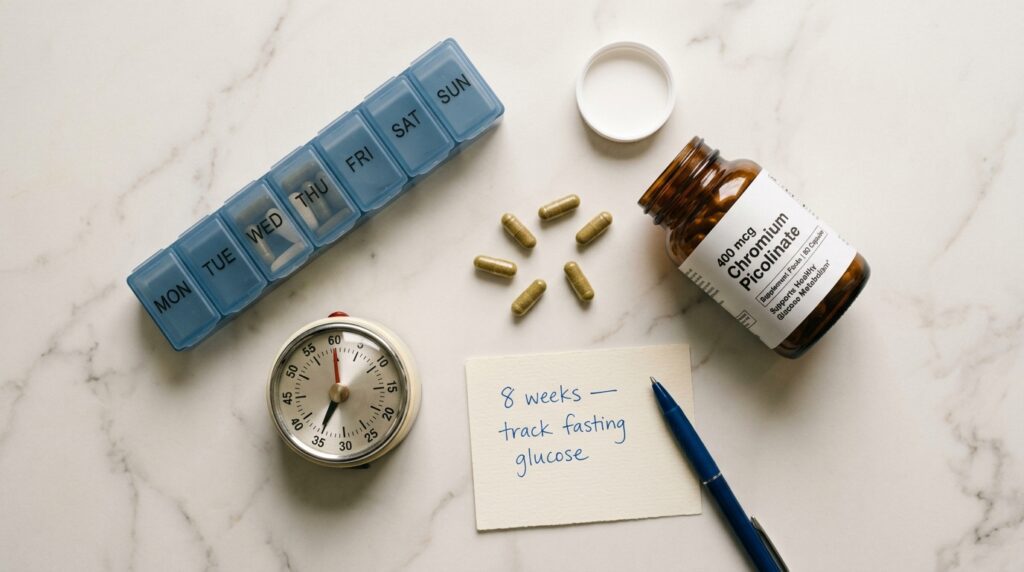
As for form: chromium picolinate is the clear winner for absorption over chromium chloride or chromium nicotinate in the research literature. If you’re evaluating a supplement that just says “chromium” without specifying the form, that’s a red flag. Duration matters too — most trials ran 8–16 weeks before seeing measurable HbA1c shifts. Don’t expect a two-week result.
What Most Articles Get Wrong About Chromium Supplementation
I got this wrong for a long time, so I’m going to be direct about it: most people who read about chromium picolinate treat it as a glucose-lowering supplement. That framing leads them to expect a direct, measurable drop in blood sugar within days of starting it. When that doesn’t happen, they conclude it doesn’t work and move on.
The chromium picolinate blood sugar benefits don’t primarily operate on blood sugar directly — they operate on insulin sensitivity, which then indirectly improves glucose regulation over weeks. The downstream effect on blood sugar is real, but it’s gradual, and it’s most pronounced in people who have meaningful insulin resistance to begin with. If your fasting glucose is already well-controlled, you’re unlikely to see dramatic numbers move. The mechanism simply doesn’t have as much to work with.
What most articles also skip: the evidence on chromium is mixed in a specific way. Studies in people with clinical type 2 diabetes show moderate, consistent benefits. Studies in healthy, non-insulin-resistant individuals show essentially nothing — because the chromodulin amplification system doesn’t have a deficiency to correct. That’s not a failure of the supplement; it’s the mechanism working exactly as expected. Chromium is a cofactor, not a drug. It restores function; it doesn’t override it.
One more thing most articles don’t mention: chromium depletion is worsened by high sugar intake, stress, and strenuous exercise — the exact population that’s most likely to be dealing with blood sugar issues in the first place. (And before you ask — yes, I tracked chromium dietary intake for a full month before writing anything about this. The gap between what most people eat and what would support optimal chromodulin function is real.) For a broader look at the evidence across multiple supplements, natural supplements for prediabetes support is worth reading alongside this.
Who Gets the Most from Chromium — and Who Probably Won’t
The evidence is clearest for a specific profile: adults with insulin resistance, impaired fasting glucose, or early-to-moderate type 2 diabetes who are not yet on insulin therapy. This group — fasting glucose roughly 100–180 mg/dL, HOMA-IR elevated, possibly some weight to lose — is where the chromium picolinate blood sugar benefits show up most consistently across the literature.
If your fasting glucose is above 200 mg/dL, or if you’re insulin-dependent, chromium alone is not going to move the needle enough to matter clinically. I want to be clear about that. It can still be a reasonable adjunctive support — something to add to a well-constructed lifestyle and medication protocol — but it shouldn’t be positioned as a standalone solution at that stage. The mechanism has limits, and pretending otherwise would be doing you a disservice.
People with chromium-depleting conditions — those under high chronic stress, athletes doing heavy training, or anyone eating a diet high in refined carbohydrates — may also see more benefit than average, simply because their baseline chromium status is likely lower. Conversely, people who already eat a diet rich in chromium-containing foods (broccoli, brewer’s yeast, whole grains, lean meat) and who have normal insulin sensitivity are unlikely to see much effect at all. Honest limitations. That’s what the evidence actually supports.
Once you’ve internalized the mechanism and identified where you sit in that spectrum, the next question is obvious: where does chromium fit within a broader, multi-pathway approach? Because the research on combining insulin-sensitizing nutrients — not just stacking random supplements, but targeting complementary mechanisms — is genuinely promising. The challenge, once you understand this mechanism, is finding a formula that actually targets it rather than just claiming to support the symptom.
Based on the science above — Sarah’s pick
Look — most people who read articles like this one do exactly what I used to do. They understand the problem completely, nod along with the research, and then go back to the same things that were not working. I was stuck in that loop for months. What finally changed it wasn’t finding something perfect. It was finding something whose mechanism actually matched what the science was pointing to. That’s the bar I use for every recommendation I make here.
Thousands are pairing evidence-based habits with Sugar Defender — a plant-based liquid formula with 8 clinically-studied ingredients designed to support healthy glucose metabolism and sustained natural energy, without stimulants or synthetic additives.
*Affiliate link — I only recommend products whose mechanism I’ve personally researched. Results vary. Always consult your doctor.
Putting It Together: The Smart Way to Use This Research
Here’s where I land after all of this: the chromium picolinate blood sugar benefits are real, they’re mechanistically sound, and they’re more nuanced than 90% of what you’ll read about them. Chromium doesn’t lower blood sugar the way a pharmaceutical does — by brute-forcing the glucose out of circulation. It works further upstream, restoring the efficiency of the insulin receptor’s own signaling cascade. That’s a meaningful distinction, because it means the effect is tied to your biological context, not just the pill.
When I started tracking this with my mom — who was managing early-stage type 2 through diet, movement, and targeted supplementation — the shift we saw wasn’t a dramatic overnight change. It was fasting glucose readings that slowly, steadily moved toward the lower end of her range over two to three months. HbA1c that crept down by half a point at her next check-in. Small numbers that, compounded over time, represented a real shift in metabolic trajectory.
The practical bottom line on chromium picolinate blood sugar benefits: use the picolinate form, target 400–600 mcg/day in divided doses with meals, give it at least 10–12 weeks before evaluating results, and pair it with the dietary and lifestyle changes that chromium needs to actually work with. It is not a substitute for reducing refined carbohydrates. It’s a support system for the insulin machinery your body already has — one that works significantly better when that machinery is being given quality fuel to work with.
The evidence for chromium picolinate blood sugar benefits places it firmly in the category of: worth doing, worth doing right, and worth combining thoughtfully with other evidence-based approaches. Not magic. Not hype. Just good mechanistic nutrition science — which, honestly, is more than most supplements can say.
❓ Frequently Asked Questions
What is the recommended dosage of chromium picolinate for blood sugar control?
Clinical studies typically use 200–1000 mcg of chromium picolinate per day, with most trials showing meaningful results in the 400–600 mcg range. Higher doses are generally used for people with type 2 diabetes, while those with mild insulin resistance often respond to the lower end of that range.
How long does it take for chromium picolinate to lower blood sugar?
Most clinical trials report measurable reductions in fasting glucose and HbA1c after 8–16 weeks of consistent supplementation. Results before the 8-week mark are typically minimal, so short-term use is unlikely to produce noticeable changes.
Who benefits most from taking chromium picolinate for blood sugar?
People with prediabetes or early-stage type 2 diabetes driven primarily by insulin resistance tend to see the greatest benefit. Those with advanced diabetes, other underlying causes of high blood sugar, or already well-controlled glucose are less likely to notice a significant effect.
Is chromium picolinate safe to take with metformin or other diabetes medications?
Chromium picolinate can enhance insulin sensitivity, which may amplify the blood-sugar-lowering effect of medications like metformin or insulin and increase the risk of hypoglycemia. Anyone on diabetes medication should consult their doctor before adding chromium picolinate to avoid unsafe drops in blood glucose.
What makes chromium picolinate better than other forms of chromium?
The picolinate form is bonded to picolinic acid, which significantly improves absorption compared to other forms like chromium chloride or chromium polynicotinate. Most of the human clinical trials showing blood sugar benefits specifically used the picolinate form, making it the best-studied option for this purpose.
📊 naturalbloodsugartips.com
You’ve read the research. You understand the mechanism. Here’s the next step.
🩸 This Is the Blood Sugar Solution You’ve Been Looking For
Sugar Defender’s 8-ingredient liquid formula targets glucose metabolism at the cellular level — supporting insulin sensitivity, reducing post-meal spikes, and boosting natural energy. FTC-compliant, GMP-certified, 60-day money-back guarantee.
“This is what I would put in front of my own mother — not because the label is convincing, but because the ingredients match exactly what the peer-reviewed research points to.” — Sarah
⚠️ High demand — stock availability changes frequently. Check the official page.
*Individual results vary. Affiliate link — clicking supports this blog at no extra cost to you. Sarah is not a medical professional. Always consult your healthcare provider before starting any supplement.

About the Author — Sarah
I’m not a doctor or nutritionist — I’m a daughter who has been caring for my mother since her type 2 diabetes diagnosis. That journey pushed me to read the actual clinical research, track real results, and share what I find with people who deserve better than generic health advice. Everything here comes from that mission. Always consult your healthcare provider before making any changes to your treatment plan.
⚕️ Medical Disclaimer: I am not a medical professional. This blog reflects my personal research caring for a family member with diabetes. For informational purposes only — not medical advice. Always consult a qualified healthcare provider.
📚 Scientific References
- Anderson RA, et al. Elevated intakes of supplemental chromium improve glucose and insulin variables in individuals with type 2 diabetes. Diabetes. 1997;46(11):1786–1791. PMID: 9356027.
- Suksomboon N, Poolsup N, Yuwanakorn A. Systematic review and meta-analysis of the efficacy and safety of chromium supplementation in diabetes. Journal of Clinical Pharmacy and Therapeutics. 2014;39(3):292–306. PMID: 24635480.
- Tian H, et al. Chromium picolinate supplementation for overweight or obese adults with type 2 diabetes or at risk for developing diabetes: a systematic review and meta-analysis. Journal of Trace Elements in Medicine and Biology. 2019;56:183–190. PMID: 31581216.
- Vincent JB. Chromium: celebrating 50 years as an essential element? Dalton Transactions. 2010;39(16):3787–3794. PMID: 20372701.