
Food and Inflammation: The Complete Guide to Eating Right

📋 Table of Contents
How Food and Inflammation Changed the Way I Saw My Mom’s Health
I still remember sitting across the kitchen table from my mom, watching her wince as she got up from her chair — her knees aching, her energy completely drained, and her blood sugar numbers nowhere close to where they needed to be. It was the moment I started obsessing over the connection between food and inflammation, and honestly, it changed everything for us. I wasn’t a doctor. I was just a worried daughter with a laptop, a library card, and a deep need to help the woman who raised me feel better. What I discovered over the following months wasn’t just about diabetes — it was about how the food we eat every single day can either quietly fuel inflammation in our bodies or help calm it down.
If you’ve been reading about chronic pain, fatigue, blood sugar issues, or even heart health, you’ve probably seen the word “inflammation” come up over and over again. That’s not a coincidence. Researchers and health experts increasingly point to chronic, low-grade inflammation as a root contributor to many of the most common health struggles Americans face today. And the good news — the part that genuinely gave me hope — is that what we put on our plates has a real and measurable impact on that process.
What Inflammation Actually Is — And Why It Matters
Before we talk about solutions, it helps to understand what we’re actually dealing with. Inflammation isn’t always the enemy. Acute inflammation — like the swelling around a cut or a sprained ankle — is your immune system doing exactly what it’s supposed to do. It’s protective. The problem starts when inflammation becomes chronic, lingering in the background for months or even years without an obvious trigger. This kind of persistent, low-level inflammation has been linked to conditions ranging from type 2 diabetes and arthritis to cardiovascular disease and even cognitive decline.
I was surprised to learn just how much diet plays into this. When I started digging into the research, I found study after study showing that certain foods actively promote inflammatory pathways in the body, while others contain compounds that help cool that response down. Understanding the foods that trigger inflammation was honestly the first step that made everything else click into place for us.

🦴 Move Freely Again — Try Joint Genesis
Thousands of people over 40 are discovering Joint Genesis — a daily capsule built around Mobilee®, a patented ingredient shown to support the synovial fluid that cushions and lubricates your joints.
Check Availability Inside the US →Foods That Fight Inflammation Naturally
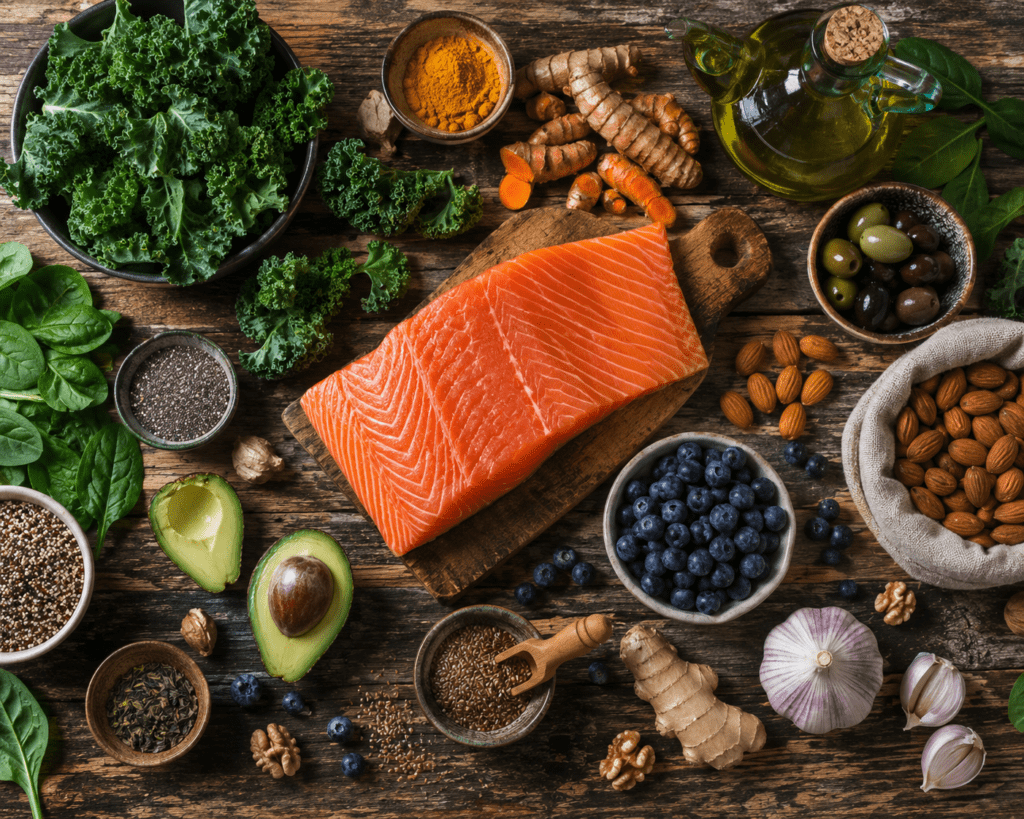
Once I understood what we were up against, I got excited about what we could actually do. There’s a remarkable list of everyday, accessible foods that have been studied for their natural anti-inflammatory properties. We started adding these to my mom’s meals gradually, and within a few weeks, she told me her joints felt less stiff in the mornings. I can’t promise that will happen for everyone, but here’s what the research — and our kitchen — taught me works:
- Fatty fish like salmon, sardines, and mackerel — rich in omega-3 fatty acids, which have been shown in multiple studies to reduce levels of inflammatory markers like C-reactive protein (CRP).
- Leafy greens like spinach, kale, and Swiss chard — packed with antioxidants and polyphenols that help neutralize free radicals and reduce oxidative stress.
- Berries — especially blueberries, strawberries, and tart cherries — contain anthocyanins, potent plant compounds with documented anti-inflammatory effects.
- Extra virgin olive oil — contains oleocanthal, a compound that works similarly to ibuprofen in reducing inflammation, according to researchers.
- Turmeric — the curcumin in turmeric is one of the most researched natural anti-inflammatory compounds out there, and my mom now has it in her golden milk every evening.
- Nuts, especially walnuts and almonds — provide healthy fats, magnesium, and vitamin E, all of which support a calmer inflammatory response.
We also started exploring anti-inflammatory meals for beginners to make these ingredients part of our everyday routine without it feeling like a chore. Simple swaps, simple recipes — that’s what made it sustainable for us.
How Food and Inflammation Are Connected in Everyday Eating
Here’s what I want people to understand — this isn’t about being perfect or following a rigid diet. The relationship between food and inflammation is something that plays out across the cumulative effect of your everyday choices. You don’t have to overhaul your entire life overnight. But it does mean paying attention to patterns. Ultra-processed foods, refined sugars, trans fats, and seed oils high in omega-6 fatty acids are the biggest dietary culprits when it comes to promoting chronic inflammation. These are the staples of the standard American diet, and they’re everywhere.
My mom had been eating what most people would consider a “normal” diet — cereals, white bread, packaged snacks, occasional fast food. Nothing extreme. But the cumulative inflammatory load of those everyday choices was significant. Swapping refined grains for whole grains, replacing vegetable oils with olive oil, and cutting back on added sugar made a real difference — not just in her inflammation markers, but in her energy levels and blood sugar stability.
If you want to go deeper on the supplement side of things, I also spent time researching options and found a really solid breakdown of anti-inflammatory food supplements reviewed by others on a similar journey — worth a read if you’re curious about what might complement a whole-food approach.
Building an Anti-Inflammatory Plate: Practical Tips That Actually Work
I’ve learned that the simplest framework is the most sustainable one. Rather than memorizing lists or counting macros, think of building your plate with these guiding principles in mind:
- Fill half your plate with colorful vegetables and fruits — color diversity means antioxidant diversity, which means better natural defense against inflammation.
- Choose whole grains over refined ones — brown rice, oats, quinoa, and barley over white bread and white pasta.
- Make healthy fat your friend — avocado, olive oil, and fatty fish instead of processed vegetable oils and fried foods.
- Season with purpose — turmeric, ginger, garlic, and cinnamon aren’t just flavors; they’re functional foods with real anti-inflammatory value.
- Hydrate consistently — water helps flush metabolic waste and keeps every system in your body running more efficiently, including your immune response.
- Limit added sugars and processed foods — read labels, and aim to reduce — not necessarily eliminate — these from your daily routine.
One thing that surprised me is how quickly the body can respond to dietary changes. My mom noticed she was sleeping better within two weeks of shifting her eating habits. Her morning stiffness gradually improved over the following month. Her doctor even commented on improvements in her inflammatory markers at her next check-up. I’m not claiming food is a cure-all — please always work with your own healthcare team. But I do believe, from everything I’ve read and lived, that what we eat is one of the most powerful levers we have.
The journey with food and inflammation is ongoing — it’s not a destination but a practice. Some days are better than others. Some weeks we do great and some weeks we slip back into old habits. But having this knowledge, knowing which choices move us toward less inflammation and which move us away from it, makes all the difference. And sharing it with you feels like the most useful thing I can do.
Start where you are. Add one anti-inflammatory food this week. Swap one processed ingredient for a whole food alternative. Build from there. That’s exactly what we did, and it’s been one of the most meaningful things I’ve ever done for the person I love most. It can work for you, too.

💪 Rediscover Pain-Free Movement with Joint Genesis
Joint Genesis combines Mobilee® hyaluronan matrix with French maritime pine bark, ginger root, boswellia, and BioPerine® — a research-backed formula to support joint comfort, flexibility, and long-term mobility.
👉 Claim Your Supply With Free Shipping Today⚠️ Update: Due to high demand, stock is limited. Check availability now.
*Results may vary. Affiliate link.

About the Author — Sarah
I’m not a doctor or nutritionist — I’m a daughter who has been caring for my mother since her type 2 diabetes diagnosis. That journey pushed me to research natural alternatives and evidence-based lifestyle changes. Everything I share comes from that personal mission: to help my mom live better, with more energy and less dependence on medication. Always consult your healthcare provider before making any changes to your treatment plan.
⚕️ Medical Disclaimer: I am not a medical professional. This blog reflects my personal research caring for a family member with diabetes. For informational purposes only — not medical advice. Always consult a qualified healthcare provider.
📚 Scientific References
- Calder PC. Omega-3 fatty acids and inflammatory processes: from molecules to man. Biochemical Society Transactions. 2017;45(5):1105-1115. PMID: 28900017.
- Minihane AM, Vinoy S, Russell WR, et al. Low-grade inflammation, diet composition and health: current research evidence and its translation. British Journal of Nutrition. 2015;114(7):999-1012. PMID: 26228057.
- Giugliano D, Ceriello A, Esposito K. The effects of diet on inflammation: emphasis on the metabolic syndrome. Journal of the American College of Cardiology. 2006;48(4):677-685. PMID: 16904534.
- Neuhouser ML. The importance of healthy dietary patterns in chronic disease prevention. Nutrition Research. 2019;70:3-8. PMID: 31174704.